
AI as Enterprise Decision Infrastructure
Updated: Jul 28
Architecting Authority, Context, and Systems in the Age of Autonomous Intelligence

The CEO looked at the dashboard: 500 active AI pilots, 47 external vendors, and zero measurable impact on operating margin.
Across every business unit, teams were celebrating localized wins—a customer-service copilot drafting replies 20% faster, a coding assistant accelerating unit tests, and a marketing tool generating campaign copy in seconds. Yet at the P&L level, operating expense had not declined, decision cycles had not shortened, and systemic risk had increased.
The enterprise conversation around artificial intelligence has hit a ceiling. For several years, executives have approached AI through the narrow lens of individual enablement: tool selection, productivity pilots, and localized automation.
Copilots draft copy, summarize threads, write code, and search knowledge bases. Task-specific software optimizes narrow steps. Emerging agents automate multi-step routines across software boundaries.
While these advancements represent meaningful technical progress, evaluating AI solely as a software utility masks a far more fundamental transition: AI is evolving from an application category into core enterprise infrastructure. Enterprise Decision Infrastructure is the emerging layer that connects enterprise context, decision logic, authority, execution, observability, and human judgment.
It is fast becoming the connective layer through which modern companies perceive operational realities, evaluate trade-offs, execute actions, and continuously adapt.
This shift transforms the foundational management challenge:
Legacy Question: "Where should we deploy AI tools within our existing workflows?"
Infrastructure Question: "How must the enterprise be re-designed when intelligence is natively embedded across its decisions, workflows, applications, and operating model?"
Answering the latter requires moving beyond fragmented AI experimentation toward what can be termed Enterprise Decision Infrastructure (EDI).
1. The Historical Infrastructure Progression
Enterprise technology evolution over the last four decades follows a remarkably consistent pattern. Emerging technologies regularly enter the market as specialized, point-solution applications before eventually becoming part of the underlying operational environment.

The trajectory unfolds across four distinct phases:
Specialized Product: A novel capability addresses an acute problem far better than legacy platforms. A distinct software category is born, where vendors differentiate on specialized feature depth.
Platform Integration: As the capability becomes essential, major enterprise platforms acquire, clone, or standardize it into shared horizontal services.
Subsumption into Infrastructure: The standalone category fades from view. The capability does not disappear; rather, it becomes so ubiquitous that it forms part of the enterprise baseline.
Migration of Advantage: Merely owning the technology no longer confers a competitive moat. Strategic advantage moves "up the stack"—to organizational design, decision architecture, and workflow orchestration.
Historical Precedents
Technology Category | Initial Point-Solution Phase | Ultimate Infrastructure Role
|
Business Intelligence | Standalone reporting databases and isolated OLAP cubes. | Ubiquitous analytics layer embedded across all applications & workflows. |
Constraint-Based Optimization | Niche planning tools requiring specialized operations research expertise. | Standard execution capability inside ERP, SCM, and pricing engines. |
Process Workflow | Departmental process engines and basic task routing software. | Cross-functional enterprise orchestration and integration fabric. |
Identity & Access | Basic directory lookup services and standalone password managers. | Comprehensive fabric for trust, zero-trust security, and governance. |
The Core Law of Enterprise Technology: The most valuable technologies do not fade away because they fail; they disappear from isolated view because they succeed, becoming embedded directly into the fabric of daily enterprise operations.
Artificial intelligence is now crossing this exact architectural threshold.
2. The Architectural Threshold: From Tasks to Systems
Treating an AI assistant that drafts an email as a standalone productivity tool is operationally reasonable. However, when an autonomous AI agent reads customer profiles, interprets contract terms, calculates discounts, communicates across enterprise systems, commits corporate finances, and updates production schedules, treating it as an isolated tool introduces profound operational risk.

At scale—where an organization may deploy thousands or millions of specialized agents—intelligence cannot reside within a single application or LLM. Instead, it becomes distributed across an interconnected mesh:
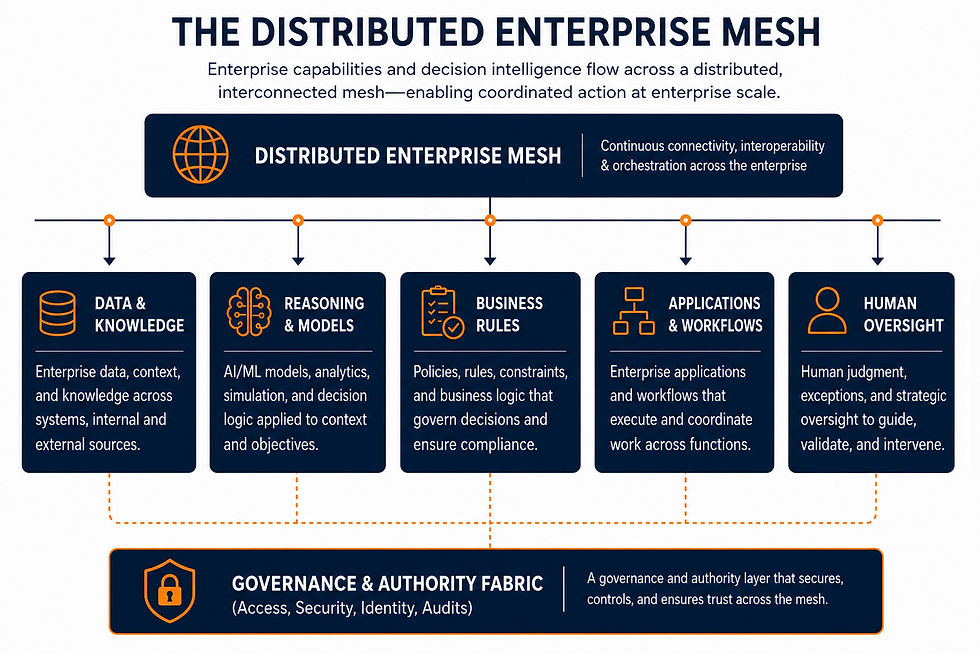
When intelligence is distributed at this magnitude, the core strategic challenge ceases to be access to intelligence—which is rapidly becoming a commoditized utility. The core challenge becomes systemic coordination:
What context is each agent permitted to read?
What specific boundaries constrain its decision-making authority?
What corporate resources can it unilaterally commit?
When is it architecturally required to escalate to human management?
How are its downstream decisions audited, evaluated, and improved?
At agent scale, AI governance and system architecture begin to converge.
3. Applications vs. Infrastructure
To understand why traditional software models fail under agent deployment, we must distinguish between task-level applications and enterprise infrastructure.
Dimension | Task-Level Applications | Decision Infrastructure
|
Primary Objective | Accelerates individual activity. | Coordinates system-wide execution. |
Operational Scope | Single user, isolated workflow. | Multi-departmental, cross-system. |
Target Unit of Value | Time savings/speed per task. | Decision quality, velocity, & risk mitigation. |
Primary Focus | Execution of local output. | Alignment with context & governance. |
Consider how this distinction manifests in practice across core enterprise functions:
Customer Service Example
Application Level (Copilot) | Infrastructure Level (EDI System)
|
Helps a representative draft a support response 20% faster. | Evaluates real-time customer lifetime value, checks contractual SLA limits, verifies refund authorization caps, determines policy exceptions, and executes cross-ledger adjustments. |
Supply Chain Example
Application Level (Agent) | Infrastructure Level (EDI System)
|
Identifies a delay and suggests adjusting a production schedule. | Balances plant capacity, working capital constraints, shipping penalty rates, supplier terms, and strategic account priorities before authorizing execution. |
An intelligent recommendation holds zero practical value if the enterprise lacks the architectural framework to authorize, coordinate, execute, and audit the decision across functional silos.
4. The Six Pillars of Enterprise Decision Infrastructure
Enterprise Decision Infrastructure (EDI) represents the unifying architectural layer that binds context, analytical logic, optimization, rules, identity, and human oversight into a reliable execution system.

Pillar 1: Shared Understanding (Context & Semantics)
Automated decisions demand precise operational context. Without standardized enterprise semantics, separate agents operating across disparate departments will act on technically accurate but organizationally conflicting assumptions. EDI establishes durable data layers, explicit business definitions, and shared domain context across all models.
Pillar 2: Decision Logic (Multi-Modal Intelligence)
Different business problems require different forms of intelligence. Relying exclusively on Large Language Models for every corporate choice introduces fragility and inefficiency. EDI coordinates a tailored mix of analytical techniques:
Intelligence Type | Optimal Use Case | System Integration
|
Predictive Analytics | Demand forecasting, churn risk scoring. | Probabilistic scoring engines. |
Constraint Optimization | Logistics, scheduling, dynamic pricing. | Mathematical solvers (LP / MILP). |
Deterministic Rules | Regulatory compliance, security policy. | Hard-coded logic gates & policy engines. |
Generative / LLM Reasoning | Unstructured text analysis & synthesis. | Natural language reasoning engines. |
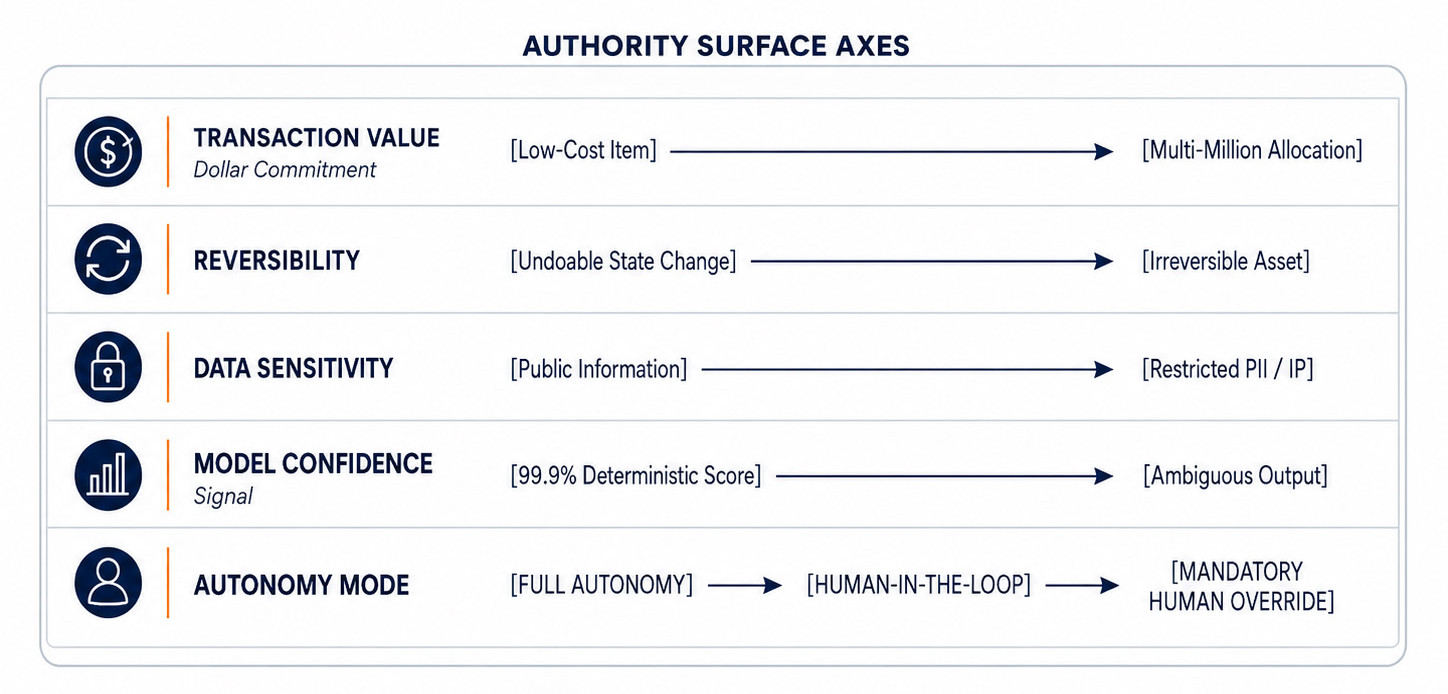
Pillar 3: Governed Authority (The Permission Surface)
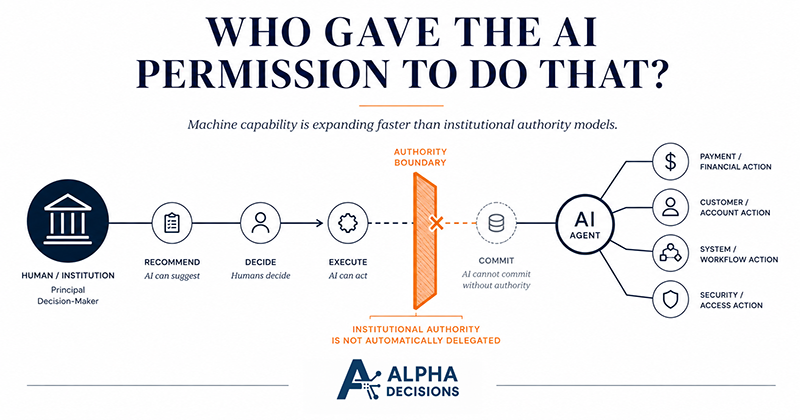
Capability does not equal authorization. An agent may possess the technical ability to grant a contract concession, but that does not mean it should be allowed to do so. EDI codifies a dynamic Authority Surface based on operational dimensions:
Pillar 4: Coordinated Execution (System Orchestration)
Decisions only yield value when they trigger actions. Agents must move beyond conversational interfaces to coordinate downstream executions—updating ERP ledgers, modifying CRM states, altering logistics routes, or triggering sub-workflows—while remaining strictly bound to corporate governance.
Pillar 5: Observability and Assurance (Traceability)
Distributed intelligence requires rigorous operational monitoring. Enterprise oversight demands complete traceability into:
Which specific agent executed an action?
What exact data sources and model parameters were referenced?
What logic pathways were evaluated?
What computational resources were consumed?
Which specific policy constraints governed the outcome?
Pillar 6: Human Judgment (Strategic Supervision)
EDI does not eliminate human operators; it repositions them to higher-leverage roles. As machines handle routine analytical workflows, human responsibility migrates upstream (defining objectives, constraints, and boundary rules) and downstream (managing edge-case exceptions and high-stakes trade-offs).
Legacy Task Execution | Infrastructure Boundary Design
|
Human manually reviews and approves individual invoices one by one. | A human defines governance boundaries and escalation thresholds governing millions of automated transactions. |
5. The Executive Agenda: Five Strategic Questions
Transitioning from application-level deployment to enterprise infrastructure expands the strategic mandate for executive leadership:
High-Value Decision Clusters: Which specific decisions disproportionately drive revenue, risk, margin, and velocity?
Machine Authority Boundaries: What explicit monetary, operational, and legal caps govern autonomous action?
Unified Context Architecture: How do we ensure all agents operate from identical, real-time enterprise context?
Decision Assurance Metrics: How do we measure decision quality, error costs, and latency alongside standard ROI?
Operating Model Redesign: How must organizational roles, decision rights, and team structures evolve?
Question 1: Which decisions matter most?
AI strategy must avoid chasing an endless catalog of task-level use cases. Instead, leadership must map and prioritize the core decision clusters that directly drive competitive differentiation and margin growth (e.g., dynamic capacity allocation, real-time risk pricing, automated underwriting).
Question 2: What authority should machines possess?
Executives must establish unambiguous operational boundaries. Low-impact, highly reversible actions should be assigned maximum autonomy, whereas high-value, regulated, or irreversible choices must retain explicit human sign-off regardless of model accuracy scores.
Question 3: What shared context is required?
Autonomous systems cannot coordinate effectively if different business units feed them conflicting definitions of a "customer," "margin," or "risk profile." Establishing unified semantic data layers is an inescapable prerequisite for agentic scale.
Question 4: How will performance be assured?
Traditional IT metrics (such as uptime, latency, or feature usage) are necessary but insufficient. Organizations must implement governance scorecards tracking decision velocity, accuracy variance, exception frequency, and error-cost rates.
Question 5: How must the operating model change?
Jobs are bundles of tasks. Capabilities are bundles of decisions. AI changes both. Adding intelligence to legacy processes without re-architecting workflows simply accelerates existing friction points. Operating models must be redesigned around the expanded capabilities of autonomous systems.
6. Evolution: From Systems of Record to Systems of Decision
Enterprise software design is undergoing a fundamental generational shift:
Era | Primary Focus | Core Representative Platforms
|
Systems of Record (1990s - 2010s) | Logging historical transactions, state changes, and event logs. | ERP (SAP,Oracle), CRM (Salesforce), HRIS (Workday). |
Systems of Engagement (2010s - 2020s) | Facilitating user interaction, communication, and task workflows. | Collaboration tools (Slack, Teams), customer portals, ticketing systems. |
Systems of Decision (2020s & Beyond) | Sensing context, evaluating options, and executing choices. | Enterprise Decision Infrastructure (Agentic orchestration layers). |
Enterprise Decision Infrastructure unifies analytics, optimization, and workflow into a continuous operational loop:
7. The Autonomous Enterprise
The ultimate destination of this shift is not an enterprise devoid of human workers, but rather an autonomous enterprise—an organization capable of sensing, evaluating, acting, and adapting at a speed and scale impossible under traditional, manual coordination models.
Pillar | Operational Requirement
|
Shared Context | Unified semantic data layer ensuring humans and agents share state awareness. |
Governed Authority | Explicit permission matrices defining precise execution limits per agent. |
Assured Execution | Reliable cross-platform orchestration across legacy and modern software. |
Closed-Loop Learning | Systematic outcome tracking to continuously refine decision models. |
Strategic Implications
As underlying frontier AI models continue to advance and the cost of accessing intelligence continues to decline, simply owning access to advanced models provides zero durable competitive differentiation.
Commoditized Inputs (Low Moat) | Architectural Integration (High Moat)
|
|
|
When every market participant has equal access to powerful AI models, competitive advantage accrues exclusively to organizations that integrate these models into superior, robust, and well-governed decision systems.
The enterprise AI transition will not be won by the organization that deploys the greatest number of disconnected tools. It will be won by the enterprise that deliberately designs the better decision system.
Technology creates possibilities. Organizations create advantage through superior decisions.


Comments