
The Bottleneck Moved. Did the Enterprise?

Why AI can solve one problem and expose the next—and why the real management advantage may be learning to adapt faster than the bottleneck moves
At Meta, code changes to the internal software platforms and infrastructure employees use increased 220% year over year. That sounds like exactly the kind of productivity gain companies are hoping AI will deliver.
But there was another number. Changes that resulted in new or improved features actually reaching Meta users increased only 36%.
There was more. Internal teams reported reliability warning signs as AI-generated code increased. Major technical and security incidents rose 40%, while the time employees spent “firefighting” them increased 70%. Meta later moderated parts of an ambitious organizational redesign that assumed AI agents would advance faster than they ultimately did. These figures do not prove that AI coding failed at Meta. They show something more useful: one part of the system changed much faster than the parts around it. (Reuters)
Code became easier to produce. Getting useful, reliable software to the customer did not become equally easy.
Faster somewhere is not necessarily faster everywhere.
A month ago, I wrote about this problem in Constraint Migration: The Next Challenge of Enterprise AI. The basic argument was simple: when AI removes or relaxes one bottleneck, the enterprise does not become free of constraints. Something else becomes limiting. (Alpha Decisions | Strategy. AI. Results.)
Since then, the evidence has become richer. We can now see the same pattern in software development, cybersecurity, autonomous operations, and even the physical infrastructure supporting AI itself. More importantly, the emerging evidence suggests that the management challenge is bigger than finding the next bottleneck.
The bottleneck can move again.
And again.
The real advantage may therefore come from building an enterprise that can move with it.
Faster Somewhere Is Not Faster Everywhere
You do not need to be an industrial engineer to understand the problem.
Imagine a busy restaurant that finds a way to prepare meals twice as fast. If the kitchen was the reason customers were waiting, the improvement is valuable. But suppose there are still only two servers, a crowded pickup counter, and one person taking payments. Before long, meals are waiting instead of customers.
The kitchen really did become more productive. The restaurant did not become twice as productive.
The bottleneck moved.
The same pattern appears everywhere once you start looking for it. A hospital can diagnose patients faster and discover that beds or discharge capacity now determine patient flow. A sales organization can generate more qualified opportunities and overwhelm implementation. A factory can increase production at one workstation and simply create a larger queue in front of the next one. A security team can detect more suspicious activity than its analysts can investigate.
For generations, industrial engineering and operations research have studied these problems through capacity planning, queueing, production flow, and system optimization. Eliyahu Goldratt made one version of the idea accessible to a much broader management audience through the Theory of Constraints: a system's performance is not determined by how efficiently every individual part operates. It is heavily influenced by the part currently limiting the flow of the whole system.
That distinction between local improvement and system performance matters enormously for AI because AI can change an activity's capacity far faster than the surrounding organization can adapt.
The old management problem is becoming much faster.
We Have Seen This Movie Before
New technologies have moved constraints before.
Early factories provide a useful example. Mechanical power was once transmitted from a central steam engine through shafts, belts and pulleys. Machines had to be arranged partly around how power could physically reach them. The power system therefore helped determine the factory layout.
Electric motors changed that. Machines could increasingly have their own power source and be placed where the flow of production made the most sense, rather than where a belt could reach them. The real opportunity was not simply replacing one power source with another. Electricity gave managers the freedom to redesign the factory.
Modern economic research finds that electrification was accompanied by significant productivity gains, capital investment, and organizational change. The precise speed varied by place and circumstance, but the broader lesson has held up: new technology creates much more value when organizations redesign around what the technology has made possible. (National Bureau of Economic Research)
Electricity did not simply make the old factory cheaper. It changed what the factory could become.
AI may eventually have a similarly broad effect because it changes the economics of something organizations have always treated as scarce: human effort applied to analysis, coding, coordination, communication and increasingly execution.
That means we should expect the organization built around yesterday’s scarcity to start showing strain.
The Bottleneck Can Move Again
Meta offers another example that makes the story more interesting.
In separate research on software engineering, Meta reported that significant lines of code per human-landed software change increased 105.9% year over year and the number of software changes per developer rose 51%. Agentic AI accounted for more than 80% of the growth.
But as code supply increased, a different problem became visible: the share of changes receiving timely review declined. Developers could produce changes faster than the existing review process could absorb them. (arXiv)
Meta did not respond by adding human reviewers at the same rate AI was adding code. It changed the system.
Its RADAR system determines which lower-risk software changes can proceed through automated review using eligibility rules, risk scoring, automated code review and deterministic checks. Meta reports that RADAR has reviewed more than 535,000 software changes and automatically landed more than 331,000. The researchers also reported substantially lower revert and production-incident rates among RADAR-reviewed changes. (arXiv)
Look at what happened.
First, AI made code production easier. Then code review became relatively scarce. Meta increased review capacity through automation. Once review becomes less limiting, something else can become more important: architecture, testing, deployment, product judgment, security, customer adoption, or simply whether the additional software creates enough business value to justify producing it.
Systems engineers might describe this as a recursive process. The ordinary-language version is more useful:
The bottleneck can move again.
Fixing the next bottleneck changes the system again. That can expose another one.
This is why AI transformation cannot be managed as a one-time exercise in automating today's work. The organization needs to keep asking what the success of the last intervention has now made important.

What Happens When Machines Move Faster Than Their Supervisors?
Cybersecurity makes the problem unusually visible because speed itself can become consequential.
Attackers have always searched for vulnerabilities, stolen credentials, and looked for paths into valuable systems. Historically, much of that work required scarce human expertise and time. AI can reduce those costs by allowing research, testing, and adaptation to happen faster and in parallel.
Dream Security recently reported recovering the working environment of a multi-agent system used against government entities in Asia. According to the company, the system conducted 12 attack waves over four days and cracked 85 employee accounts while adapting its attack paths. The case should be treated carefully because Dream is the reporting security vendor, and the affected governments and attacker have not been independently identified. But the mechanism is important: AI can make sophisticated offensive activity cheaper to produce and easier to scale. (Dream Group)
Vulnerabilities didn't suddenly appear because AI exists. Weak authentication, excessive privileges and exposed interfaces have been with us for years.
AI did not invent the vulnerabilities. It changed the economics of exploiting them.
When offensive activity becomes faster and cheaper, the defensive bottleneck can move toward identity, prioritization, verification, containment, and the ability to intervene quickly enough to matter.
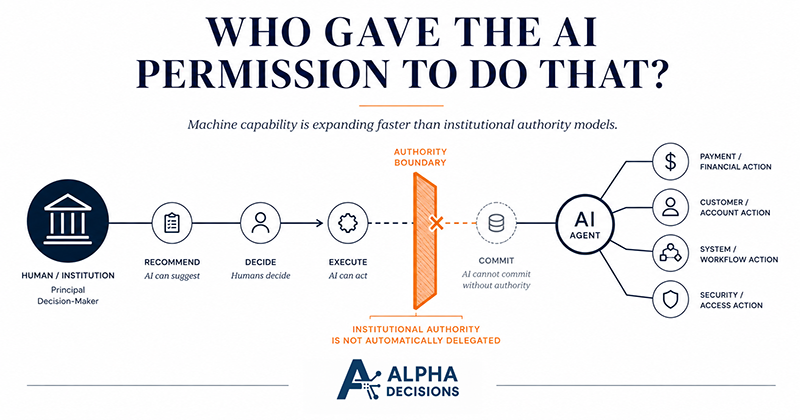
The U.S. Army Cyber Command faces the same issue on the defensive side. Army Cyber is training agents for recognizable work roles such as developers, data engineers, and cyber analysts. The agents can operate at machine speed, but Army Cyber has deliberately kept consequential risk decisions with humans while it determines where the authority boundary should eventually move. Its commander described the tension plainly: the agents move much faster than their human counterparts. (Breaking Defense)
That creates a very different kind of bottleneck.
The machine may be able to perform the work. The scarce resource becomes the institution's ability to determine what the machine should be allowed to do, when a person must intervene, and how quickly that intervention can occur.
This is where “human in the loop” falls short. If machines can produce decisions faster than humans can meaningfully review them, adding a human approval step can simply create another queue.
The important question is not whether a human appears somewhere in the process. It is whether the organization can still exercise effective control.
NIST's work on software and AI-agent identity is moving in the same direction. Its 2026 concept paper explicitly focuses not only on identifying agents but on authorization, auditing, non-repudiation, and controls around what agents can access and do. (NIST)
As machine execution becomes easier, governing execution becomes more valuable.
Security therefore is not an adjacent issue in AI transformation. It is one of the places where constraint migration becomes easiest to observe.
When One Thing Becomes Easier, Something Else Becomes More Valuable
The same pattern is visible far outside any individual enterprise.
AI models continue to improve while the cost of accessing machine intelligence falls. Yet the infrastructure required to produce that intelligence is becoming extraordinarily capital-intensive.
J.P. Morgan Asset Management estimates that cumulative data-center and AI investment could reach approximately $5.3 trillion by 2030, with well over half requiring external financing. It also describes electricity as an emerging binding constraint on the AI buildout. Data centers currently account for roughly 4% of U.S. electricity consumption, a share J.P. Morgan says could roughly triple by 2030. A data center can sometimes be built in two or three years, while new generation and transmission capacity can take considerably longer. (JPMorgan)
There is no contradiction here.
Machine intelligence can become cheaper for the person using it while power, grid access, chips, cooling, construction capability and capital become more valuable to the companies producing it.
When one thing becomes easier to get, something else often becomes more important.
Economists would describe this partly in terms of relative scarcity. A much older idea from William Stanley Jevons adds another piece. Jevons observed in the nineteenth century that making steam engines more efficient did not necessarily reduce coal use. Greater efficiency made steam power attractive for more applications, which could increase total demand.
Jevons helps explain why usage can rise as something becomes cheaper. Constraint Migration asks the question that comes immediately afterward:
What becomes scarce next?
If intelligence gets cheaper, demand for compute can rise. If compute expands, power can become limiting. If data-center construction accelerates, grid connections, turbines, transformers and capital can become more valuable.
The same mechanism operates at a different scale, but the management logic is familiar.
Abundance in one part of a system does not eliminate scarcity.
It relocates it.

What If the Enterprise Cannot Use What AI Produces?
There is another constraint that may prove even more important for most companies.
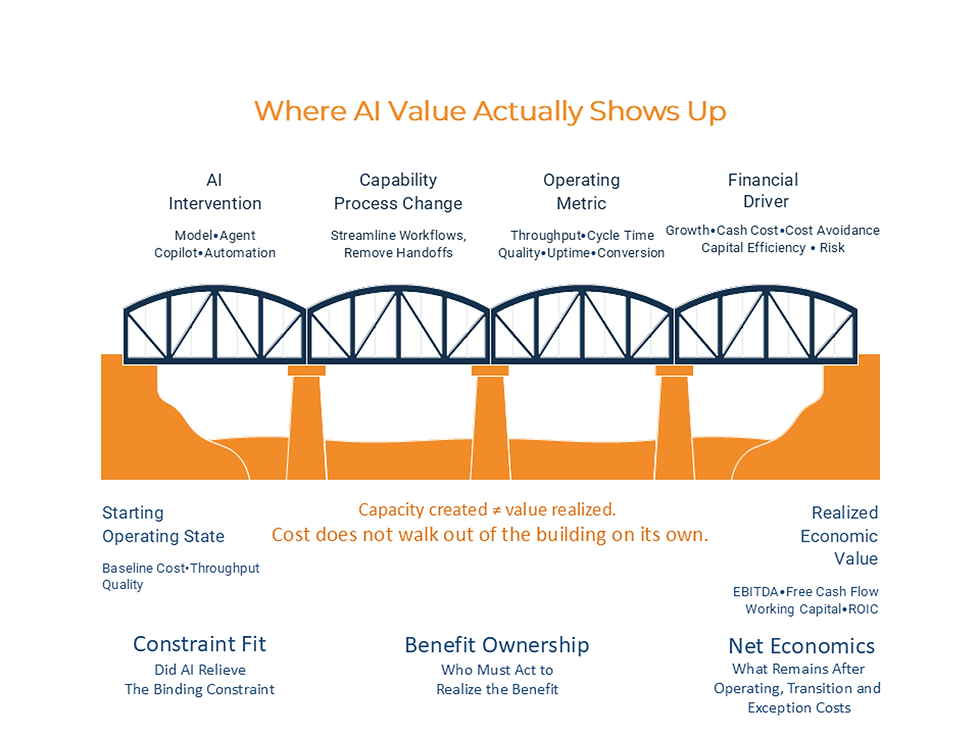
Suppose AI allows 1,000 employees to save four hours every week. That represents 4,000 hours of newly available capacity. The productivity improvement can be completely real.
But what happens to the 4,000 hours?
Payroll does not automatically decline. Revenue does not automatically increase.
Customers do not automatically buy more. Unless management can redeploy the capacity into something economically consequential, the organization has simply created additional potential.
This is why capacity created is not value realized.
The same problem appears in many forms. A company can generate more code than it can deploy. It can produce more analysis than executives can use. It can create more leads than sales or fulfillment can absorb. It can generate more AI recommendations than managers can evaluate. It can possess more autonomous capability than its governance systems are prepared to authorize.
In each case, the bottleneck has moved from producing the work to using the work.
Researchers may describe parts of this problem through concepts such as absorptive capacity. Managers can ask a much simpler question:
Can the rest of the enterprise actually use what AI is now capable of producing?
That question connects constraint migration directly to economic value. The objective is not to maximize AI output. It is to improve the performance of the enterprise system.
Sometimes that means adding capacity downstream. Sometimes it means eliminating an obsolete approval step. Sometimes it means redesigning jobs. Sometimes it means changing authority. And occasionally it means recognizing that additional production has little value because the real constraint is customer demand.
That last possibility deserves more attention. If AI makes it possible to produce ten times as much marketing content, software, analysis or customer outreach but the market does not need ten times as much, the binding constraint may simply have moved to demand.
Technology can create abundance. It cannot repeal economics.
A Successful AI Program Can Create Its Own Next Problem
This shift in perspective matters.
When a new bottleneck appears, executives may be tempted to interpret it as evidence that the AI investment failed. Sometimes that will be correct. AI can underperform, organizations can implement it badly, and expected benefits can fail to materialize.
But a new bottleneck can also appear because the original improvement worked.
If software production accelerates enough that review becomes limiting, code production probably did improve. If agents operate quickly enough that human authorization becomes the bottleneck, machine capability probably expanded. If cheaper AI creates enough demand that electricity becomes scarce, adoption probably increased.
The mistake is not necessarily creating the next problem.
The mistake is failing to anticipate it.
That changes the management question. Instead of asking only, “How much productivity will this AI create?” leaders should ask, “If this productivity actually appears, what will happen to everything around it?”
That is a harder question, but it is much closer to how enterprise value is actually created.
If the AI Works, What Happens Next?
This suggests a practical addition to how companies evaluate AI initiatives.
Most AI reviews already ask sensible questions about technical feasibility, cost, reliability, and expected value. A Constraint Migration Review adds a systems perspective without requiring executives to become systems engineers.

It can begin with six ordinary questions.
1. What is limiting performance today? Start with the business outcome rather than the AI tool. If customer retention, production throughput or product-release speed is the objective, what is actually preventing that outcome from improving today?
2. What will AI make faster, cheaper or easier? Be specific. Is AI increasing analysis, coding capacity, customer-response capacity, decision speed, forecasting accuracy or autonomous execution?
3. Where will the pressure move next? Imagine the AI succeeds beyond expectations. What part of the surrounding system will receive more work, more decisions, more demand or more risk?
4. What could become the new bottleneck? It might be verification, human judgment, integration, fulfillment, capital, demand, authority, security, physical infrastructure or management attention.
5. What should we redesign before that happens? The answer may not be more people. Meta responded to review scarcity by redesigning review. Army Cyber is reconsidering the division of decision rights between humans and agents. Other organizations may need different workflows, capacity, incentives, controls or operating models.
6. How will we know when the bottleneck moves again? Queue lengths, cycle times, exception volumes, incident rates, customer wait times, human review loads, utilization and realized financial outcomes can reveal where pressure is accumulating.
These questions turn Constraint Migration from an interesting observation into a management discipline.
They also change what AI transformation means. The objective is not to predict one perfect future operating model and implement it. The objective is to build an organization that can notice when the system has changed and adapt accordingly.
Not Every Improvement Creates a New Crisis
The argument has an important boundary.
Not every AI improvement immediately produces another bottleneck. Sometimes the activity being improved really is the binding constraint and the rest of the system has enough spare capacity to absorb the additional output. A plant constrained by equipment downtime may immediately sell more product when uptime improves. A service organization purchasing expensive outside labor may convert automation directly into lower cash costs.
Constraints can also be difficult to identify. Real businesses are not neat production lines. Demand changes. Product mix changes. Several resources may become limiting under different circumstances. Organizational politics, regulation or incentives may matter as much as physical capacity.
Constraint Migration therefore should not become a label attached to every business problem.
The claim is narrower:
When technology materially changes the capacity or economics of one part of an interconnected system, management should expect the importance of the surrounding constraints to change.
The larger the technological change, the more important it becomes to look for that movement.
AI can produce very large changes very quickly.
The Management Capability Is Adaptation
The first phase of enterprise AI naturally focused on capability. What can these systems do? Which tasks can they automate? How much time can they save? Where can agents operate?
Those questions remain important. But they are increasingly becoming the beginning of the management conversation rather than the end.
Software organizations may discover that producing code is easier than integrating and operating it. Security organizations may discover that detecting or executing at machine speed is easier than governing actions at machine speed. Business leaders may discover that generating analysis is easier than improving decisions. AI providers may discover that making intelligence cheaper increases the strategic value of power, capital and physical infrastructure.
None of this argues against AI.
Quite the opposite. It describes what happens when a powerful technology starts changing the system around it.
The enterprise will never become constraint-free. As one limitation becomes less important, another will eventually matter more. Fix that one, and the system changes again.
The enduring management capability is therefore not simply the ability to remove bottlenecks. It is the ability to recognize what has become scarce, understand why it matters, and redesign the enterprise before the new constraint prevents the organization from capturing the value the technology made possible.
A month ago, I ended with the question:
Where will the constraint move next? (https://www.alphadecisions.com/post/the-bottleneck-moved-did-the-enterprise)
The evidence since then suggests an even more consequential question:
When the bottleneck moves, can the enterprise move with it?
That may be one of the defining management capabilities of the AI era.

Comments