
Constraint Migration: The Next Challenge of Enterprise AI
- Aug 2
- 5 min read
Why competitive advantage will come from redesigning enterprise systems—not simply deploying more AI.

Executive Summary
Much of today's enterprise AI conversation revolves around foundation models, copilots, agents, and automation. These developments are important, but they describe the technology rather than the enterprise.
Enterprises are systems of interconnected capabilities constrained by limited resources, expertise, governance, and decision-making capacity. Every major technology changes where those constraints exist. Artificial intelligence is no exception.
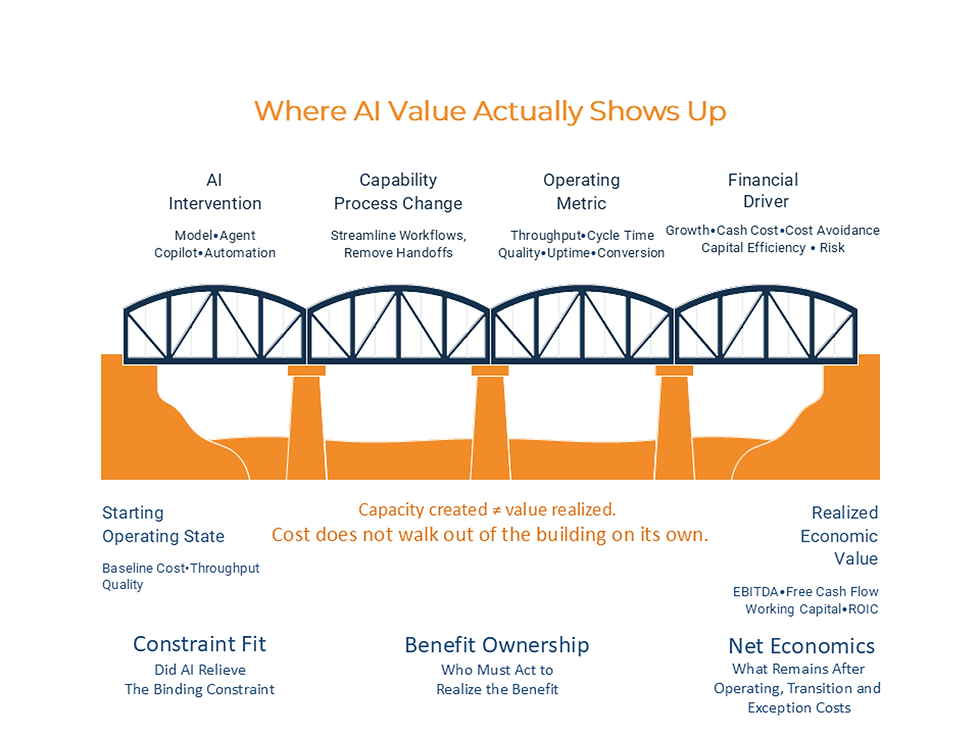
When AI removes one bottleneck—whether software development, document analysis, customer support, or knowledge discovery—it rarely improves the entire enterprise by itself. Instead, the constraint migrates. The limiting factor becomes something else: trusted context, executive attention, authority, governance, verification, organizational learning, or management capacity.
The organizations that create lasting competitive advantage over the next decade will not simply deploy more AI. They will recognize where the enterprise constraint has moved and redesign the operating model around it.
That may become the defining management challenge of the AI era.
AI Is Solving Yesterday's Bottlenecks
Artificial intelligence has already removed constraints that enterprises struggled with for decades.
Tasks that once required hours of specialized expertise can now be completed in minutes. Software developers generate working code with AI assistance. Legal teams summarize contracts almost instantly. Analysts explore enormous datasets conversationally. Customer service organizations automate interactions that once required large teams of trained employees.
These improvements are genuine. They explain why organizations are investing aggressively in foundation models, copilots, and increasingly autonomous AI agents.
Yet a curious pattern is emerging.
Individual teams often become dramatically more productive while enterprise performance improves far less than expected. Software development accelerates, yet projects remain delayed. Analytical capacity expands, yet strategic decisions do not necessarily improve. Customer interactions become automated, yet organizational complexity continues to increase.
The question is no longer whether AI improves local productivity. The question is why those improvements so often fail to produce proportional enterprise outcomes.
Industrial engineering has long offered an explanation. Improving a system's existing bottleneck rarely produces lasting gains because once the original constraint is removed, another immediately becomes the limiting factor.
AI is not eliminating enterprise constraints.
It is moving them.
From Automation to Constraint Migration
Most enterprise AI strategies begin with a familiar question:
Which work should we automate?
That remains an important question.
It is no longer sufficient.
Automation improves individual activities.
Transformation improves enterprise performance.
A systems perspective asks something fundamentally different:
If AI succeeds here, what becomes the enterprise's next binding constraint?
That question changes how transformation should be managed.
Instead of measuring AI deployment, executives begin observing how constraints migrate across the organization.
When AI accelerates software development, integration, architecture, testing, and governance become more important.
When AI makes analysis abundant, trusted context and executive judgment become scarce.
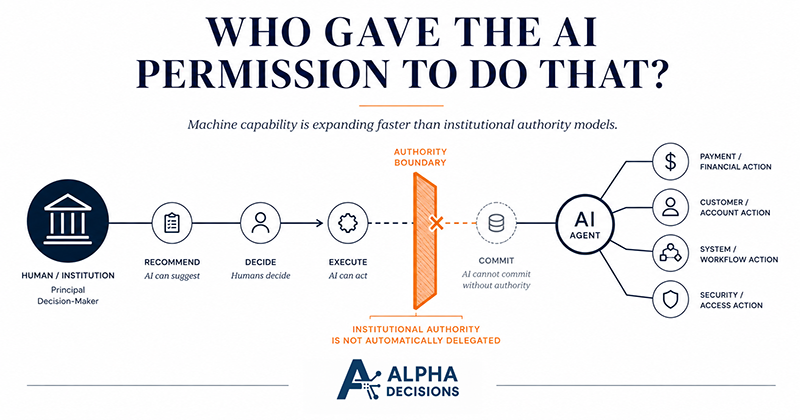
When autonomous agents execute work independently, authority, verification, accountability, and organizational trust become the limiting factors.
When routine work disappears, organizational learning and change capacity determine how rapidly new capabilities can be absorbed.
The enterprise has not become unconstrained.
The constraint has simply moved.
Constraint Migration offers a different way to think about enterprise transformation. Rather than asking how AI automates today's work, executives should ask where tomorrow's bottleneck will emerge.
Evidence Is Emerging Across Independent Domains
A management framework becomes more compelling when independent evidence begins pointing toward the same conclusion.
That is precisely what is happening.
Recent developments in enterprise technology, economics, cybersecurity, regulation, and management theory are converging around a common pattern. Each begins from a different problem. Together, they describe the same enterprise transition.
The Emerging Control Plane
One of the strongest signals emerging across enterprise AI is not coming from a single technology vendor, government, or academic discipline. It is emerging independently across all of them.
Economists are discussing reasoning budgets, token allocation, and model routing. Enterprise architects are designing orchestration layers that determine which models, agents, and tools should perform each task. Cybersecurity leaders are shifting their attention from protecting individual models to governing ecosystems of interacting agents. Regulators are drafting standards for identity, delegated authority, permissions, and execution controls.
At first glance, these appear to be unrelated developments.
They are not.
They are independent responses to the same underlying shift.
As AI execution becomes inexpensive and abundant, control becomes scarce.
Recent enterprise developments illustrate this transition. Organizations such as EY are introducing model-routing architectures that allocate intelligence according to business value rather than defaulting to the most capable—and most expensive—models. Emerging research further suggests that the orchestration layer surrounding AI—how context is managed, tools are selected, work is delegated, and execution is governed—can have a greater impact on enterprise economics than the choice of foundation model itself.
Cybersecurity is evolving in the same direction. Palo Alto Networks and Databricks emphasize runtime identity, policy enforcement, observability, and governance across entire agent ecosystems rather than simply securing individual models. Meanwhile, China's TC260 draft guidance treats AI agents as identifiable, permissioned, and accountable actors whose delegated authority must remain traceable throughout the execution chain.
These developments are occurring independently, yet they point toward the same conclusion.
Management theory explains why.
Eliyahu Goldratt demonstrated that removing one bottleneck simply exposes the next. W. Ross Ashby showed that increasingly capable systems require equally capable mechanisms of control. Jay Galbraith argued that as organizational complexity grows, the organization's capacity to process information must grow with it.
Artificial intelligence appears to extend these principles into knowledge work.
As machine intelligence becomes abundant, the enterprise constraint migrates toward something entirely different: the ability to orchestrate intelligence safely, economically, and accountably.
This represents a profound shift in how competitive advantage is created.
For decades, organizations competed by acquiring better technology. Increasingly, they will compete by governing how intelligence is allocated, how authority is delegated, how autonomous decisions are verified, and how AI systems coordinate with one another.
The strategic asset is no longer the model alone.
It is the enterprise control plane—the policies, identities, authority boundaries, economic guardrails, verification mechanisms, and runtime controls that determine how intelligence is trusted, allocated, and allowed to act.
The organizations that lead the next decade may not be those with the most powerful AI.
They may be those with the strongest enterprise control plane.
What This Means for Enterprise Leaders
The dominant executive question today is:
Where should we deploy AI?
That remains important.
A better question is beginning to emerge:
If AI succeeds here, what becomes our next enterprise bottleneck?
That single question changes transformation strategy.
Instead of optimizing isolated workflows, leaders begin redesigning the enterprise around its new constraint. Instead of measuring AI adoption, they measure enterprise performance. Instead of asking where humans can be removed, they determine where human judgment should be eliminated as unnecessary friction, where it should augment machine capability, and where it must remain as an essential safeguard.
Constraint Migration does not diminish the importance of AI.
It explains why AI alone is insufficient.
Conclusion
Every industrial revolution has followed a remarkably similar pattern.
Technology removes one constraint.
Another immediately becomes the limiting factor.
The organizations that create enduring competitive advantage are rarely those that adopt technology first. They are the ones that recognize where the bottleneck has moved and redesign their operating model before everyone else.
Artificial intelligence appears to be following exactly the same trajectory.
The first wave of enterprise AI focused on making knowledge work faster.
The next wave will focus on orchestrating intelligence, authority, judgment, and control across increasingly autonomous enterprises.
The question for executives is no longer:
"How can AI automate this work?"
It is:
"Where will the constraint move next?"
The answer to that question may become one of the defining competitive advantages of the AI era.
References
China National Information Security Standardization Technical Committee (TC260), Draft Practice Guide for AI Agent Security Requirements (2026).
EY, AI Pulse Survey (2026).
The Harness Effect: How Orchestration Design Sets the Token Economics of Enterprise Agentic AI (2026).
Palo Alto Networks, Securing the Agentic AI Frontier with Palo Alto Networks and Databricks (2026).
Eliyahu M. Goldratt, The Goal.
W. Ross Ashby, An Introduction to Cybernetics.
Jay R. Galbraith, Organization Design.

Comments