
Where Does AI Value Actually Show Up?

Why productivity gains, time savings, and ROI calculators are not enough to build an AI business case
Executives are moving from asking what AI can do to asking a harder question: if we invest materially in AI, where should the economic value actually appear? The market has plenty of answers—hours saved, prompts submitted, code generated, tickets handled, agents deployed, licenses activated—but most describe activity or capability rather than financial return. That distinction matters as AI spending moves from experimentation into capital allocation, because a technology can be impressive, widely adopted, and genuinely productive while still failing to create measurable enterprise value. The durable lesson from earlier technology transitions is simple: technology creates possibilities; economics determines where value can exist; management determines whether it is realized.
I have spent more than three decades helping executive teams build value hypotheses and business cases around major technology transitions, from optimization and ERP to cloud, cybersecurity and now AI. Some of the early value calculators my teams built were deliberately simple because they served a narrow purpose: create an initial hypothesis, quantify an order of magnitude, and earn the next executive conversation. They were never intended to withstand the full operational and financial scrutiny of a major transformation. That distinction is increasingly important in AI, because arithmetic can estimate potential, but a business case must explain causality.
The problem is not the calculator. It is what happens after the calculation.
A familiar AI calculation starts with time. If 5,000 employees save three hours per week and their loaded labor cost averages a certain amount, the spreadsheet can produce a very large annual “benefit” in seconds. The arithmetic may be perfectly correct, but the economic conclusion may still be wrong because payroll does not automatically fall, revenue does not automatically rise, and fragmented minutes do not automatically reassemble into monetizable capacity. Time saved is capacity created, not value realized. Cost does not walk out of the building on its own; management must decide how that capacity will be converted into revenue, avoided cost, lower external spend, greater throughput, or some other economically consequential outcome.
That does not make productivity unimportant. Research on more than 5,000 customer-support agents found that generative AI assistance increased productivity by about 15% on average, with the largest gains among less experienced workers. That is a real operating improvement, and exactly the kind of evidence executives should care about. But the study measures issues resolved per hour, not free cash flow, EBITDA, or enterprise value; management still has to build the bridge between those levels. (Stanford Graduate School of Business)
The same distinction is visible in more recent enterprise evidence. SolarWinds’ 2026 State of ITSM report found substantial reported time savings across core IT service-management tasks, and 84% of respondents said AI had met or exceeded ROI expectations. Yet 52% said overall workload had increased after adoption, while only 7% said actual adoption costs matched what they had planned; teams were spending new time on maintenance, output review, training and data work. AI removed effort in one part of the system while creating cost and workload elsewhere. (SolarWinds)
The missing bridge is economic conversion
A defensible AI business case needs more than a benefit estimate because each stage of value creation answers a different question. It has to show what the technology changes operationally, why that change matters economically, and what management action converts the improvement into a measurable result. The causal chain is straightforward, but skipping even one link can turn a plausible benefit into little more than an assumption.
AI Intervention → Capability / Decision / Process Change → Operating Metric → Financial Driver → Realized Economic Value
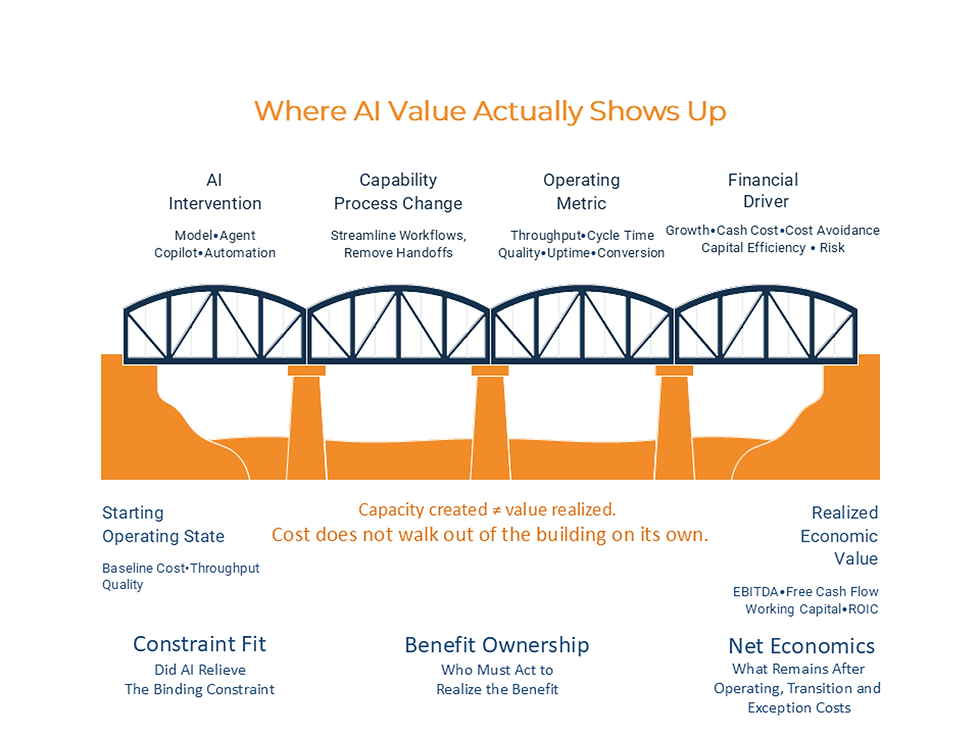
The intervention might be a coding assistant, forecasting model, service agent, fraud detector or predictive-maintenance system. The first question is whether it actually changes a capability, decision or process: does work move differently, does a decision improve, does an exception disappear, does a handoff vanish, does a machine stay available longer? If no operating behavior changes, adoption has produced activity but not transformation. The relevant measure is therefore not simply whether people are using AI, but whether the operating system of the enterprise is behaving differently because they are using it.
The second question is whether that change moves a meaningful operating metric. Faster drafting is less important than end-to-end sales-cycle time; more code is less important than release throughput; more automated tickets are less important than first-contact resolution, service cost and retention. The operating metric then has to connect to a financial driver such as revenue, gross margin, cash operating cost, working capital, asset utilization or expected loss. Only after that driver changes and the enterprise actually captures the benefit do we reach realized economic value.
This is the economic conversion gap that simple ROI models often skip. A salesperson who saves two hours of preparation each week creates latent capacity. If those hours produce more qualified customer conversations, improve conversion, increase average deal size or allow the company to grow without adding sales capacity, the time saving becomes economic value. If the salesperson simply has two less-congested hours, the productivity gain may still improve work, but it should not be booked as financial return.
Before valuing the gain, find the constraint
The next discipline comes from systems thinking and the Theory of Constraints. In an interconnected operating system, improving the speed of a nonconstraint does not necessarily improve system throughput; it may simply create a larger queue in front of the real bottleneck. This is why local productivity metrics can mislead in AI. A task can become dramatically faster while the customer, factory, software release, claim, loan or supply chain moves no faster at all.
Software development now provides a clear example. A 2026 longitudinal study of 802 developers found that per-capita pull-request throughput eventually doubled under an enterprise AI mandate, but reviewer load also roughly doubled and automated review expanded substantially. That is not evidence that AI failed; it is evidence that the system changed. Once code generation becomes cheaper and faster, review, specification, architecture, security, testing or deployment can become relatively more consequential, so management must redesign around the new constraint rather than merely celebrate higher coding output. (arXiv)
This principle has an important boundary condition. If the activity AI accelerates is genuinely the binding constraint, additional capacity can have immediate economic value. A capacity-constrained plant that reduces downtime can ship more product; a sales organization with more demand than selling capacity can monetize additional customer-facing time; a service operation paying for overflow labor can reduce external spend when automation absorbs volume. Task productivity matters, but its value depends on where the capacity enters the system and what the enterprise can do with it.
There are only a few ways enterprise value ultimately appears
Most AI value cases converge into five economic pathways. Profitable growth comes from better conversion, retention, pricing, capacity, speed-to-market or new offerings. Cash-cost removal occurs when labor, contractor, vendor or process costs actually leave the income statement, while cost avoidance and operating leverage come from growing output without adding resources at the historical rate. Capital efficiency improves through lower inventory, better asset utilization, higher uptime or faster working-capital cycles, and risk economics creates value when AI credibly reduces the expected frequency or severity of loss.
This is why “AI value equals labor savings” is far too narrow. An initiative that launches a product two months earlier, retains more high-value customers, improves yield on a constrained production line, reduces inventory by five days, or avoids the next tranche of planned hiring may create more value than a visible headcount reduction. The business case should follow the economics of the enterprise rather than the easiest metric to multiply. It should also distinguish between benefits that appear on the income statement, benefits that improve cash or capital efficiency, and benefits that increase strategic capacity without immediately reducing an accounting expense.
Gross benefit is not net value
Enterprise AI also introduces ongoing costs: model and inference consumption, orchestration, data pipelines, licenses, monitoring, evaluation, security, integration, exception handling and human review. Some will fall as technology improves; others may rise with usage or migrate between budgets. The relevant comparison is therefore not “AI costs X and saves Y of theoretical labor,” but the incremental economic benefit created by the redesigned system minus the full incremental cost of operating it at scale.
Transition economics complicate the picture further. Organizations often carry old and new operating models simultaneously: legacy software plus AI infrastructure, existing staff plus implementation teams, manual controls plus automated controls, and current workflows plus redesigned ones. Training, data remediation, integration and organizational change can make the economics look worse before steady-state benefits emerge. A strong business case therefore models the J-curve—how much investment and disruption occur before benefits ramp, how long dual costs persist, and what must be true for the organization to cross into positive economic return.
This distinction can materially change investment decisions. Two AI initiatives might promise the same steady-state benefit, but one may require twelve months of parallel operations, extensive data remediation and heavy human review while the other reaches scale with limited organizational disruption. Their headline ROI may look similar while their cash profiles, execution risks and time-to-value are radically different. Capital allocation should recognize those differences before an executive committee approves the investment, not after the transition costs arrive.
The residual work may be more expensive than it looks
Automation economics are rarely linear. Suppose an AI service agent handles 80% of incoming inquiries; it is tempting to assume that 80% of labor cost can eventually disappear. But the remaining 20% may contain the most ambiguous, emotional, regulated or commercially consequential cases, requiring more experienced people, more investigation and more time than the historical average. Removing routine volume can therefore change the composition of the work as much as it changes the quantity.
This is exception economics. As AI absorbs routine volume, the residual human workload can become smaller but systematically harder, and the unit cost of remaining work can rise even while total volume falls. The value model should therefore estimate not only the percentage of work automated but also the cost, complexity and risk distribution of what remains. Otherwise, a business case can overstate labor savings while simultaneously underestimating the expertise and control capacity the redesigned system will require.
Be careful when management changes the denominator
Causal attribution becomes especially difficult when organizations restructure in anticipation of AI. Mark Ma and colleagues have documented a pattern in which AI investment announcements and AI-related layoffs move together, including cases where companies reduced headcount before making subsequent AI investments. Their research also found that optimistic management discussion of AI had no significant relationship with productivity outcomes, while employee sentiment toward AI was more consequential. That should make executives cautious about declaring technological productivity from a ratio that management itself has already altered. (Fortune)
If revenue per employee rises after a headcount reduction, an AI rollout and a reorganization all occur in the same period, what caused the improvement? Did AI raise output, did the denominator simply shrink, did service levels deteriorate, or did remaining employees absorb more work? In systems terms, management can move a constraint in anticipation of technology before proving that the technology actually relieved it. A defensible business case must separate the technology effect from simultaneous management interventions.
This is not an argument against restructuring. In some cases, management may correctly anticipate a future capacity shift and act before every productivity gain is visible in historical data. But the business case should make that assumption explicit and measure what happens afterward, rather than treating any improvement in ratios such as revenue per employee as proof of AI value. Causality matters because the next investment decision depends on knowing what actually worked.
Every benefit needs an owner
Technology teams can create the capability, but the operating business must realize the benefit. A projected labor saving does not become a financial result simply because the technology works; someone must change staffing plans, eliminate external spend, redirect capacity, increase throughput, or otherwise act on the opportunity. Value realization therefore requires an owner with both accountability for the outcome and authority over the operating levers that produce it.
This is where value engineering becomes management rather than modeling. A CIO may sponsor or deploy the technology, but usually cannot unilaterally terminate a BPO contract, change sales coverage, reduce planned hiring, alter inventory policy, or redesign a customer-service operating model. Those decisions sit with operating executives, which means the people who control the financial and operational levers must participate in the value case before deployment—not merely approve the technology budget after the assumptions have already been made.
Every material benefit should have a value hypothesis, an operating metric, a financial driver, an accountable benefit owner and a defined realization action. If the business case assumes $20 million of value but no executive owns the decisions required to produce it, the number is aspiration rather than a plan. Leaders should be accountable not only for whether the technology was delivered, but whether the operating change occurred and the economic result was captured. Benefit realization is ultimately an operating-management responsibility.
Replace the heroic ROI number with scenario economics
AI business cases should stop pretending that a single-point forecast is precision. Adoption will vary, model economics will change, exception rates will differ from assumptions, control requirements may raise costs, and constraints may move as the technology begins working. A base case, upside case and downside case are more useful than one heroic ROI percentage because they force executives to identify which variables actually control the investment outcome. They also make uncertainty visible without turning uncertainty into an excuse for avoiding the investment.
The scenarios should be operational, not merely financial. The upside case may assume that AI relieves the true constraint, adoption is high, exception rates are manageable and capacity is successfully monetized. The downside case may assume that usage grows but the constraint moves downstream, human review stays high, conversion actions are delayed and dual operating costs persist. Sensitivity analysis then becomes a management tool: the organization knows what to watch and which assumptions require intervention.
The business case should become a learning system
The final mistake is treating the approved business case as a document that becomes obsolete the moment funding is released. AI capabilities, model costs, human roles, demand levels and system constraints can change quickly, which means the value model must change with them. The business case should become a closed-loop process: measure the operating change, verify economic conversion, compare actual costs with assumptions, identify the emerging constraint, update the scenarios and redirect capital toward the highest-value opportunity.
That is a more demanding standard than counting licenses, hours or tokens, but it is also more useful. The purpose of an AI business case is not to predict an impressive ROI number before deployment. It is to create a causal model of how technology can become economic value—and then a management system for testing, realizing and updating that value as the enterprise changes. In that sense, value engineering should continue after the investment decision rather than ending when the spreadsheet is approved.
AI can make work faster, cheaper and more intelligent, but none of those outcomes is synonymous with enterprise value. Value appears only when the improvement changes the economics of the system and management captures the consequence. The most important question is therefore not simply, What can AI do? It is: What changes because AI can do it, where does the constraint move, who owns the conversion, and where does the economic value finally show up?


Comments