
Every Enterprise Is a Decision System

How strategy becomes performance through decisions
Most leaders describe their companies as organizations, operating models, processes, technology stacks, or collections of capabilities.
All of those descriptions are useful.
But they miss the deeper truth.
Every enterprise is a decision system.
A company does not turn strategy into performance simply because it has a strategy. It does not outperform because it has more data, better technology, more dashboards, or more automation. Those things matter, but they are inputs.
Strategy becomes performance only when the enterprise makes thousands of decisions well.
Some decisions are visible: where to invest, which markets to enter, how to price, what products to build, which customers to prioritize, which risks to accept, which operating model to redesign.
Most decisions are less visible: which exception to escalate, which trade-off to make, which customer issue deserves attention, which supplier constraint matters, which signal to trust, which process variation to tolerate, which opportunity to pursue, which risk to ignore.
These decisions happen every day across functions, systems, teams, workflows, and management layers.
They determine how strategy actually behaves.
The enterprise beneath the org chart
The formal organization chart tells us who reports to whom.
The process map tells us how work is supposed to flow.
The technology architecture tells us which systems support the business.
But none of these fully explains how the enterprise really performs.
Performance is shaped by the decision system underneath them.
That decision system includes:
who makes which decisions
what information they use
how trade-offs are resolved
how exceptions are escalated
how priorities are set
how judgment is applied
how risk is governed
how outcomes are measured
how the organization learns
This is where enterprise performance is created or lost.
A strategy may be brilliant at the executive level and still fail in execution if the decision system below it is fragmented, slow, inconsistent, politically distorted, or poorly informed.
The reverse is also true. A company with a clear decision system can often outperform larger competitors because it learns faster, coordinates better, and makes sharper trade-offs.
Why this matters more in the AI age
AI is forcing leaders to revisit a basic management question:
Where should intelligence be applied?
Many organizations answer this question through use cases. They ask where AI can automate activity, improve productivity, reduce effort, or accelerate work.
That is a reasonable starting point.
But it is not enough.
A use-case view asks:
Can AI improve this activity?
A decision-system view asks:
Will improving this decision change how the enterprise performs?
That is a very different question.
AI can summarize documents, generate content, automate service responses, assist sales teams, analyze financial data, write code, support forecasting, and improve countless workflows. Many of these applications create value.
But the highest-value applications of AI will not come from improving isolated activities. They will come from improving the decisions that determine enterprise performance.
Which customers should receive scarce capacity?
Which risks should be accepted, transferred, or avoided?
Which product features will change adoption?
Which claims should be escalated?
Which suppliers should receive priority?
Which markets deserve investment?
Which accounts are likely to expand?
Which operational signals indicate future failure?
Which trade-offs should be made between growth, margin, resilience, and customer experience?
These are not just tasks. They are enterprise decisions.
And when AI begins to improve them, the organization changes.
From process thinking to decision thinking
For decades, enterprise transformation has been dominated by process thinking.
That made sense.
ERP, supply chain systems, CRM, workflow platforms, and cloud applications all reinforced the idea that organizations improve by standardizing and automating processes.
Process thinking created enormous value.
It helped organizations scale, integrate, control, and measure work.
But AI shifts the management lens.
AI does not merely automate process steps. It changes how information is interpreted, how options are generated, how trade-offs are evaluated, how judgment is supported, and how decisions improve over time.
That requires decision thinking.
Process thinking asks:
How should work flow?
Decision thinking asks:
Where is judgment required, and how should it improve?
Process thinking focuses on efficiency, repeatability, and control.
Decision thinking focuses on quality, speed, consistency, trust, coordination, and learning.
The best enterprises will need both.
But in the AI age, the differentiator increasingly shifts from process automation to decision intelligence.
The hidden decision system
Every organization already has a decision system.
The problem is that most of it is informal.
It lives in meetings, spreadsheets, management habits, exception handling, approval chains, local expertise, incentives, tribal knowledge, and executive judgment.
Some parts are explicit. Most are not.
That is why so many transformation programs struggle.
They redesign systems without redesigning decisions.
They automate workflows without clarifying judgment.
They deploy analytics without changing trade-offs.
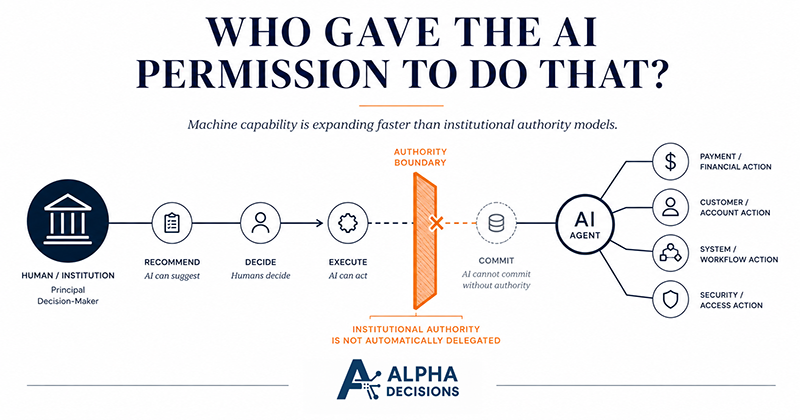
They introduce AI without determining which decisions should be improved, governed, delegated, augmented, or automated.
The result is predictable.
More tools.
More data.
More pilots.
More activity.
But not necessarily better enterprise performance.
The missing layer is decision architecture.
Decision architecture
Decision architecture is the design of how important decisions are made across the enterprise.
It clarifies:
which decisions matter most
where those decisions sit in the operating model
who owns them
what information is required
which decisions require human judgment
where AI can assist or automate
what governance is needed
how outcomes are measured
how learning flows back into the system
Without decision architecture, AI adoption becomes fragmented.
One team automates a workflow.
Another builds a model.
Another creates an agent.
Another launches a dashboard.
Each may be useful. But collectively, they may not improve how the enterprise competes.
Decision architecture connects technology to management.
It ensures that AI is not simply applied where it is easy, visible, or fashionable, but where better decisions can create meaningful business value.
Capabilities depend on decisions
In the previous article, I introduced the idea of Capability Economics.
Every enterprise operates through many capabilities.
It competes through only a few.
But capabilities do not create value in the abstract. They create value through decisions.
A retailer’s merchandising capability depends on decisions about assortment, pricing, promotion, placement, inventory, and customer segmentation.
A bank’s risk capability depends on decisions about credit, fraud, liquidity, exposure, compliance, and capital allocation.
A manufacturer’s operating capability depends on decisions about capacity, quality, scheduling, maintenance, sourcing, and constraint management.
A healthcare organization’s clinical capability depends on decisions about diagnosis, treatment, escalation, staffing, utilization, and patient risk.
A cybersecurity company’s platform capability depends on decisions about threat prioritization, product integration, account expansion, incident response, and customer risk.
The capability is the enterprise muscle.
The decision system is how that muscle is controlled.
This is why AI strategy cannot stop at capabilities. It has to identify the decisions inside those capabilities that determine performance.
Better decisions become better performance
A better decision system improves the enterprise in several ways.
It improves quality by helping people make more accurate and better-informed judgments.
It improves speed by reducing delay, ambiguity, and unnecessary escalation.
It improves consistency by making decisions less dependent on individual interpretation or local variation.
It improves trust by clarifying why decisions were made and what evidence supported them.
It improves coordination by aligning decisions across functions, systems, and teams.
It improves learning by connecting outcomes back to the assumptions and decision logic that produced them.
These are not abstract management virtues.
They are sources of competitive advantage.
The company that makes better pricing decisions will usually outperform the company with better pricing reports.
The company that makes better risk decisions will outperform the company with more risk dashboards.
The company that makes better customer prioritization decisions will outperform the company with more customer data.
The company that makes better product trade-offs will outperform the company with more product ideas.
Data matters.
Technology matters.
AI matters.
But they matter most when they improve the decisions that determine performance.
The CEO as chief decision architect
This is why Decision Intelligence is not only a technology issue.
It is a leadership issue.
The CEO and executive team must understand which decisions define the company’s advantage.
They must know where decision quality is strong, where it is weak, where it is slow, where it is inconsistent, and where it is trapped inside legacy structures.
They must ask:
Which decisions matter most to our strategy?
Which decisions determine how we compete?
Which decisions are being made too slowly?
Which decisions are being made with poor information?
Which decisions depend too heavily on individual heroes?
Which decisions should be augmented by AI?
Which decisions should remain human-led?
Which decisions should be automated?
Which decisions should be governed more tightly?
Which decisions should become part of a learning system?
These are not IT questions.
They are management questions.
And they belong at the center of AI transformation.
The new management lens
The enterprise of the future will not simply be more automated.
It will be more decision-centric.
Its most important decisions will be identified, designed, instrumented, governed, measured, and continuously improved.
Its AI systems will not sit outside the operating model. They will become part of the decision system.
Its human judgment will not disappear. It will be focused where judgment matters most.
Its competitive advantage will not come from having the same technologies as everyone else.
It will come from making better decisions, faster, more consistently, and with greater learning.
That is the deeper meaning of Decision Intelligence.
Not AI for its own sake.
Not automation for its own sake.
Not productivity for its own sake.
Decision quality as a management discipline.
Because every enterprise converts strategy into performance through decisions.
And every enterprise, whether it recognizes it or not, is a decision system.


Comments