
Orchestrating Intelligence
- Aug 7
- 6 min read
The Next Operating Model for the AI Enterprise

For the last several years, enterprises have focused on acquiring AI capability. Which model should we use? Which platform should we select? Where should we deploy copilots? Which agents should we build? How much compute will we need?
Those questions remain important, but they are rapidly becoming insufficient.
AI capability is proliferating across the enterprise. Different teams will use different models. Agents will operate across applications. Specialized systems will perform increasingly sophisticated tasks. Some intelligence will run in the cloud, some locally, and some through external services. Some decisions will justify expensive frontier-model reasoning, while others will be handled by smaller models, deterministic software, or automation. Humans will remain essential in some decisions while disappearing from others.
As this environment develops, the enterprise problem changes.
The enterprise problem is no longer acquiring intelligence. It is orchestrating intelligence.
That is the next operating-model challenge.
Intelligence Is Becoming a Portfolio
Traditional enterprise technology was relatively easy to categorize. Applications performed defined functions. Infrastructure provided computing capacity. Data platforms stored information. Humans made most consequential decisions.
AI breaks those boundaries. The enterprise will increasingly possess a portfolio of intelligence that includes frontier models, smaller specialized models, proprietary algorithms, AI agents, deterministic automation, human experts, external intelligence services, and combinations of all of them.
The management question therefore becomes: Which intelligence should be used for which decision, under what authority, at what cost, and with what level of verification?
That is fundamentally an orchestration problem.
The Most Capable Model Is Not Always the Right Model
AI discussions often assume that better intelligence should always be preferred. Enterprise economics says otherwise.
A company does not use its most expensive executive to approve every purchase order, and it does not use its most sophisticated optimization system to schedule a meeting. In the same way, it should not necessarily use the most powerful AI model for every task.
Different decisions require different combinations of capability, latency, reliability, privacy, explainability, cost, and risk. A routine classification task may require a lightweight model. A complex strategic analysis may justify expensive reasoning. A regulatory decision may require deterministic controls and human review regardless of model capability. A customer interaction may require speed more than depth.
The enterprise therefore needs to allocate intelligence economically. This is Capability Economics applied to AI.
Model Routing Is Only the Beginning
Technology providers are already developing model-routing systems that select models based on task complexity, cost, or performance. That is useful, but enterprise orchestration goes much further.
The organization must also determine whether the task should be performed by AI at all, whether an agent may act autonomously, what information it may access, what tools it may use, what evidence must support its decision, when human review is required, whether an action can be reversed, and who remains accountable.
Model routing chooses intelligence. Enterprise orchestration governs intelligence, authority, execution, and consequence together.
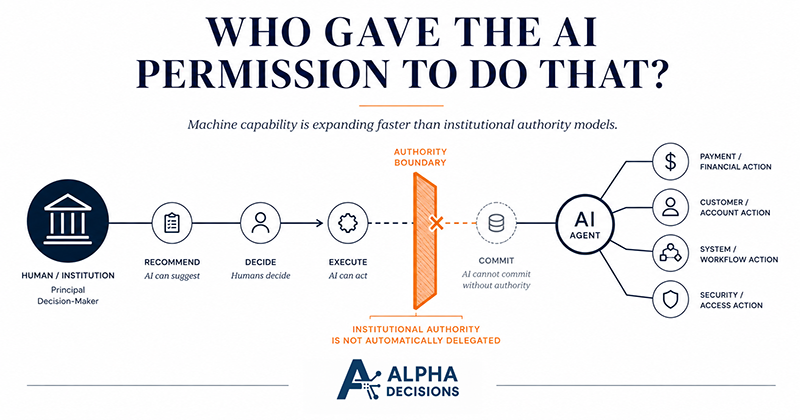
Intelligence Without Authority Cannot Act
Generative AI initially created information. Agentic AI increasingly creates action, and that distinction changes everything.
An agent may possess enough capability to negotiate a supplier issue, modify a customer account, write and deploy software, approve a transaction, change access permissions, schedule production, or initiate another agent. But capability does not imply authority.
The enterprise therefore needs an explicit answer to a new question: What is this intelligence allowed to do?
Every autonomous actor increasingly requires identity, permissions, authority boundaries, approved tools, policy constraints, escalation rules, auditability, and an accountable owner. This is why AI governance will increasingly move beyond model policies, principles, and ethics statements. Governance has to become executable.
Machine-Readable Is Not Machine-Executable
Enterprises already contain enormous amounts of policy: approval matrices, risk tolerances, operating procedures, security requirements, compliance rules, and delegations of authority. Much of this information is technically machine-readable.
That does not mean machines can safely execute against it.
A policy document might say that managers may approve “reasonable customer concessions.” A human interprets that language through years of organizational context.
An autonomous agent requires something much more precise: Which managers? Which customers? What counts as reasonable? Up to what amount? Under what circumstances? What evidence is required? What happens when policies conflict? When must the decision be escalated?
The autonomous enterprise therefore requires organizations to convert institutional intent into machine-executable authority. That is a fundamentally different challenge from simply digitizing documents.
Verification Becomes an Architectural Requirement
As machine execution expands, organizations must also rethink verification. Humans cannot inspect every AI action, but eliminating review does not eliminate the need for assurance.
Verification increasingly has to become part of the architecture itself. It may include automated policy checks, confidence thresholds, independent validation, reconciliation against systems of record, anomaly detection, simulation before execution, reversible actions, continuous observability, and human escalation for exceptions.
The objective is not to create systems that never make mistakes. No enterprise system meets that standard. The objective is to design systems in which mistakes are detected, bounded, recoverable, and accountable.
Security Becomes a System Property
Traditional cybersecurity often focuses on securing individual components: identities, devices, applications, networks, and data. AI introduces a more complicated problem.
An individual agent can be properly authenticated. Its credentials can be legitimate. Its API calls can be permitted. Its model can function correctly. Yet the overall outcome can still be unsafe because risk can emerge from interactions among multiple legitimate components.
One agent obtains information from another. That information changes a decision. The decision triggers a workflow. The workflow invokes a tool. The tool changes a system of record. Every individual action may be technically authorized while the combined sequence still violates enterprise intent.
Security therefore increasingly becomes a property of the decision system as a whole. The organization must govern not merely individual access but the behavior that emerges when autonomous components interact.
Human Judgment Becomes Another Orchestrated Resource
Human judgment belongs inside the orchestration architecture as well.
The Human Judgment Paradox tells us that people should not remain in every decision loop, but removing humans entirely is equally simplistic. The enterprise has to determine where human judgment adds value, which decisions require explicit human accountability, when confidence is too low for autonomous action, what consequences trigger escalation, and which experts should intervene.
Human attention therefore becomes another scarce resource to allocate.
The emerging operating model is straightforward in principle: machines handle the normal range; humans handle consequential exceptions. That is management by exception at machine scale.
The AI Orchestration Layer
Put these pieces together, and a new enterprise layer begins to emerge. Its purpose is not simply to orchestrate AI agents. It orchestrates intelligence itself.
It determines what intelligence should be used: model, agent, human expert, algorithm, or deterministic system. It determines what context that intelligence may access and what authority accompanies it. It allocates compute and reasoning according to economic value. It defines what verification is required, when human judgment must intervene, and how outcomes and corrections improve future decisions.
This is larger than an AI platform. It is increasingly part of the management architecture of the enterprise.
Constraint Migration Explains Why This Is Happening
The need for orchestration is not accidental. It follows directly from constraint migration.
When intelligence was scarce, enterprises focused on acquiring more intelligence. When software-development capacity was scarce, they focused on increasing development productivity. When analysis was expensive, they focused on automating analysis.
AI relaxes many of those constraints, but removing one constraint exposes another. As intelligence and execution become abundant, the constraints migrate toward coordination, authority, verification, governance, human attention, security, and organizational absorption.
The better AI becomes, the more important these management capabilities become.
That is why the next competitive advantage may not come from possessing the best model. It may come from possessing the best system for organizing intelligence.
From AI Strategy to Intelligence Strategy
Most enterprises currently have an AI strategy. They may eventually need something broader: an intelligence strategy.
An intelligence strategy asks which decisions matter most, what level of intelligence those decisions justify, which forms of intelligence should perform them, what context they require, what authority should accompany them, what should remain human, how the system should be monitored, and how the enterprise learns from outcomes.
That shifts the conversation from technology acquisition to enterprise design.
The goal is not maximum AI, and it is not maximum autonomy. The goal is the right intelligence, applied to the right decision, with the right authority, at the right cost, under the right level of control.
That is orchestration, and it may become one of the defining management capabilities of the autonomous enterprise.
Technology creates possibilities. Organizations create advantage through superior decisions.

Comments