
Technology Creates Possibilities. Decision Quality Creates Competitive Advantage

Every generation of enterprise technology has promised competitive advantage.
Manufacturing automation promised higher quality and lower cost.
ERP promised integrated operations.
The Internet promised new business models.
Cloud promised agility and scale.
Analytics promised data-driven management.
Today, artificial intelligence promises enterprise transformation.
Each technology wave has fundamentally changed how organizations operate. Each has delivered measurable value. Yet history suggests that technology alone has rarely created sustained competitive advantage.
Technology diffuses.
Competitive advantage endures.
The history of enterprise technology suggests that organizations rarely outperform because they possess better technology. They outperform because they consistently make better decisions with similar technology.
The difference lies in the quality of decisions an organization makes.
The Wrong Conversation
Many executive teams are asking:
"What is our AI strategy?"
It is a reasonable question.
It is also the wrong one.
The more important question is:
"Which decisions create the greatest value in our enterprise, and how can technology improve their quality, speed, and consistency?"
This subtle shift changes the discussion from deploying technology to redesigning the enterprise.
Technology is an enabler.
Decision-making is the operating system of the business.
Most enterprises organize around functions, processes, and technologies. Few organize around the decisions that create enterprise value. This may be the fundamental design flaw that limits the return on investment in every technology, including AI.
Every Enterprise Is a Decision System
Organizations often describe themselves by their products, markets, or capabilities.In reality, every enterprise is a complex network of interconnected decisions.
If an enterprise stopped making decisions, it would stop operating within minutes. Decisions are the smallest unit of management and the fundamental mechanism through which strategy becomes execution.
Pricing decisions.
Hiring decisions.
Capital allocation decisions.
Inventory decisions.
Supplier decisions.
Customer service decisions.
Risk decisions.
Investment decisions.
Thousands are made every day.
Some are routine.
Some are strategic.
Together, they determine growth, profitability, resilience, innovation, and shareholder value.
Yet remarkably few organizations maintain an inventory of their highest-value decisions or systematically invest in improving them.
Instead, they invest in technology.
The Pattern Across Every Platform Transformation
Having worked through successive platform transformations—from intelligent manufacturing and ERP to analytics, cybersecurity, and AI—I have found one pattern to be remarkably consistent.
The organizations that created lasting advantage were rarely those that implemented technology first.
Technology accelerated existing capabilities. Leadership redesigned how decisions were made. That distinction separated market leaders from fast followers.
Technology Eventually Becomes Infrastructure
ERP once differentiated companies. Today it is expected.
Cloud once differentiated companies. Today, it is infrastructure.
Analytics once differentiated companies. Today, it is a standard enterprise capability.
AI will likely follow the same trajectory.
Foundation models will improve.
Costs will decline.
Capabilities will become widely accessible.
When everyone possesses similar technology, technology itself ceases to differentiate.
Competitive advantage must emerge elsewhere.
The Next Competitive Frontier
The next frontier is not Artificial Intelligence.
It is Decision Intelligence.
Decision Intelligence begins with identifying the decisions that create disproportionate enterprise value.
It improves the quality and trustworthiness of information supporting those decisions.
It redesigns operating models to reduce friction, accelerate execution, and increase consistency.
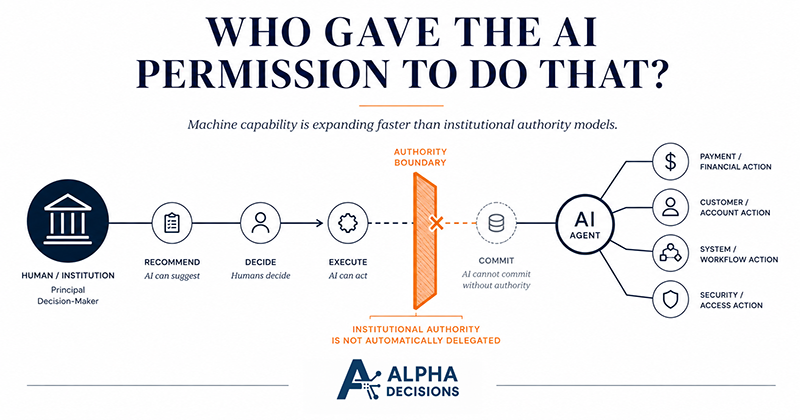
It establishes governance that determines which decisions remain human, which become AI-assisted, and which can ultimately be delegated to autonomous systems.
This represents a shift from technology transformation to management transformation.
Leadership's New Responsibility
Leadership has never been about possessing the most information.
Leadership has always been about making better decisions under uncertainty.
AI does not change that responsibility.
It amplifies it.
The executive challenge is no longer deciding where to deploy technology.
It is deciding where improved decision quality creates a strategic advantage.
Organizations that answer that question will build capabilities competitors cannot easily replicate.
Not because they own better technology.
But because they have built a superior decision system.
Decision to Consider
Imagine your competitors have access to the same AI models, cloud platforms, enterprise applications, and technology partners.
What decisions will your organization make better than theirs?


Comments