
The Architecture of the Autonomous Enterprise
Updated: Aug 28

How do governed decision systems become the enterprise operating model
The autonomous enterprise will not be built by automating tasks.
It will be built by designing and operating governed decision systems.
That distinction matters.
Many organizations still imagine autonomy as a technology end-state: more agents, more automation, more workflows, more models, more dashboards, more self-service, more machine-generated output.
Those capabilities will matter. But they are not the architecture of autonomy.
They are ingredients.
The real question is not whether AI can perform more work. It can.
The real question is whether the enterprise can govern how intelligence is applied to the decisions that shape performance.
Autonomy without architecture creates fragmentation.
One team deploys agents. Another automates workflows. Another builds analytics. Another creates copilots. Another launches dashboards. Another experiments with model orchestration.
Each effort may be useful. But if they are not connected to the enterprise’s most important decisions, they do not create an autonomous enterprise.
They create a faster version of today’s fragmentation.
The autonomous enterprise emerges when technology, data, people, processes, governance, and learning are organized around how important decisions are made, improved, and scaled.
Autonomy is about decisions, not the absence of humans
The phrase “autonomous enterprise” can easily be misunderstood.
It does not mean an enterprise without people.
It does not mean machines make every decision.
It does not mean judgment disappears.
It means the enterprise becomes more capable of making high-quality decisions with greater speed, consistency, trust, coordination, and learning.
Some decisions will remain human-led.
Some will be AI-assisted.
Some will be AI-recommended.
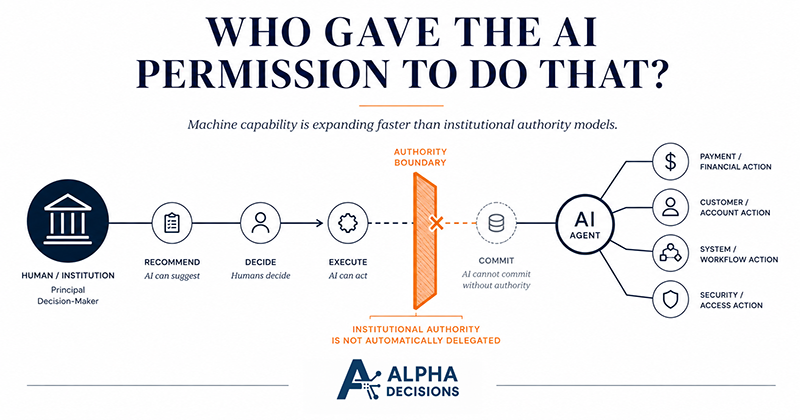
Some will be AI-executed within defined boundaries.
Some will be fully automated because the decision logic is clear, repeatable, low-risk, and governed.
The management challenge is knowing which is which.
That is why autonomy is not primarily a technology question.
It is a decision architecture question.
Where should human judgment be preserved?
Where should AI augment judgment?
Where should decisions be automated?
Where should governance be tighter?
Where should speed matter more than precision?
Where should trust matter more than efficiency?
Where should exceptions be escalated?
Where should learning loops improve the decision over time?
These are the questions that shape the autonomous enterprise.
The failure mode: automation without architecture
Most enterprises will not fail at AI because they lack access to models.
They will fail because they automate activity without redesigning the decision system.
This creates several predictable problems.
They improve productivity without improving competitive advantage.
They increase speed without improving judgment.
They generate more recommendations without clarifying accountability.
They automate workflows without resolving cross-functional trade-offs.
They create agents without defining decision rights.
They build dashboards without changing which decisions are made.
They scale AI experiments without scaling enterprise learning.
This is why many AI initiatives stall after the first wave of productivity.
Efficiency is valuable. But efficiency alone does not create an autonomous enterprise.
The autonomous enterprise requires a governed architecture for how decisions are made and improved.
The architecture of autonomous performance
The autonomous enterprise can be understood as six connected layers.
1. Technology and AI infrastructure
This is the foundation.
It includes cloud platforms, models, agents, applications, APIs, workflow systems, security, and integration capabilities.
This layer provides computational power, scalability, automation, and access to AI capabilities.
But infrastructure does not determine advantage by itself.
Most competitors will have access to similar tools, models, platforms, and vendor ecosystems.
Technology creates possibility.
Architecture determines whether that possibility becomes performance.
2. Data and context foundation
AI depends on data.
But enterprises do not operate on raw data alone. They operate through context.
Context includes customer history, product definitions, operational constraints, policies, risk thresholds, service commitments, regulatory requirements, financial logic, process history, and institutional knowledge.
Without context, AI can produce output.
With context, AI can support better decisions.
This is one of the most important differences between experimentation and enterprise-scale AI.
A pilot can run on narrow data.
An enterprise decision system requires trusted data, shared meaning, business context, and operational relevance.
3. Decision Intelligence layer
This is where Alpha Decisions places the center of gravity.
The Decision Intelligence layer connects data, models, agents, analytics, human judgment, and business logic to specific enterprise decisions.
It asks:
Which decisions matter most?
What options should be considered?
What evidence is relevant?
What trade-offs are involved?
What risks must be governed?
Who is accountable?
What should AI recommend?
What should humans decide?
What should be automated?
What should be learned from the outcome?
This is the layer that turns AI from a capability into a management system.
Without it, AI remains a set of tools.
With it, AI becomes part of how the enterprise thinks, acts, and learns.
4. Governance and trust layer
The autonomous enterprise cannot scale without trust.
Trust does not come from enthusiasm for AI.
It comes from governance.
Leaders need to know where AI is being used, what decisions it influences, what data it relies on, what assumptions it makes, what risks it creates, and who remains accountable.
This layer includes policy, ethics, privacy, security, model governance, auditability, risk management, explainability, compliance, escalation rules, and decision rights.
In the AI age, governance cannot be treated as a brake on innovation.
Done well, governance becomes an accelerator.
It allows organizations to scale AI with confidence because the boundaries, accountabilities, and controls are clear.
5. Human + AI operating model
The autonomous enterprise is not a machine operating separately from people.
It is a human + AI operating model.
Humans provide purpose, values, judgment, empathy, creativity, accountability, and strategic intent.
AI provides speed, scale, pattern recognition, consistency, simulation, prediction, and increasingly autonomous execution.
The operating model defines how these strengths combine.
It clarifies roles, decision rights, handoffs, escalation paths, exceptions, accountability, and performance measures.
This is where many organizations underinvest.
They deploy AI tools but do not redesign how work, judgment, and accountability change.
That leaves people uncertain about when to trust AI, when to override it, when to escalate, and how to learn from it.
The result is not autonomy.
It is confusion.
6. Feedback and learning layer
The autonomous enterprise must learn continuously.
Every important decision should eventually create feedback.
What was recommended?
What was decided?
What action was taken?
What outcome occurred?
Was the assumption correct?
Was the model useful?
Was the human override better?
Was the trade-off appropriate?
Should the decision logic change?
This feedback layer is what turns decisions into a learning system.
Without feedback, AI systems may automate existing logic without improving it.
With feedback, the enterprise can improve decisions over time.
This is where autonomy becomes more than speed.
It becomes adaptation.
From workflow automation to governed decision systems
Workflow automation asks:
How can we make this process faster?
Governed decision systems ask:
How should this decision be made, improved, governed, and learned from?
That is the critical shift.
For example, a customer service organization can use AI to summarize calls, draft responses, and automate routing. That may improve productivity.
But a decision-system view asks deeper questions.
Which customers should receive priority?
Which issues indicate future churn?
Which exceptions should be escalated?
Which service failures reveal product problems?
Which customers deserve proactive intervention?
Which resolution options balance cost, loyalty, and risk?
Which patterns should be fed back to product, operations, sales, and finance?
That is no longer simple automation.
That is an enterprise decision system.
The same logic applies across industries.
In banking, autonomy is not just faster document processing. It is better credit, fraud, risk, capital, and customer decisions.
In manufacturing, autonomy is not just automated scheduling. It is better decisions about constraints, quality, maintenance, capacity, suppliers, and safety.
In healthcare, autonomy is not just administrative automation. It is better decisions about patient risk, clinical escalation, resource allocation, utilization, and outcomes.
In cybersecurity, autonomy is not just alert automation. It is better decisions about threat prioritization, incident response, customer risk, prevention, and platform adoption.
The highest-value AI opportunities sit inside the decisions that define enterprise performance.
The role of differentiated capabilities
In Capability Economics, the central idea is simple:
Every capability matters.
Not every capability differentiates.
The same principle applies to the autonomous enterprise.
Some autonomous capabilities will be shared and necessary. Finance, HR, IT, legal, compliance, reporting, administration, and internal workflows will all benefit from AI.
These improvements matter.
They create efficiency, consistency, control, and capacity.
But the more strategic question is where autonomy strengthens differentiated capabilities.
Where can faster, better, more trusted decisions change customer preference?
Where can they improve margin structure?
Where can they increase resilience?
Where can they improve innovation speed?
Where can they strengthen risk selection?
Where can they improve service experience?
Where can they change market position?
The autonomous enterprise is not built by automating everything equally.
It is built by selectively redesigning the decision systems that matter most.
Why the operating model changes
As AI becomes more embedded, the enterprise operating model changes in several ways.
First, decisions become more explicit.
Organizations must identify which decisions matter, who owns them, what logic supports them, and how they are governed.
Second, decision rights become more important.
As AI agents and models influence more activity, leaders must clarify what AI can decide, what humans must approve, and what requires escalation.
Third, governance becomes embedded.
Governance cannot sit outside the operating model as a separate review function. It must become part of the decision system itself.
Fourth, learning becomes continuous.
The organization must capture outcomes and use them to improve decision logic, model performance, human judgment, and operating rules.
Fifth, leadership shifts from supervising activity to designing intelligence.
Executives will increasingly be responsible for designing how intelligence flows through the enterprise.
That is a very different management role.
The CEO as architect of enterprise intelligence
The autonomous enterprise is not a technology project.
It is a leadership agenda.
The CEO and executive team must decide where autonomy matters, where judgment must remain human, where AI should augment decisions, where automation is appropriate, and where governance is non-negotiable.
They must ask:
Which decisions define our advantage?
Which decision systems are too slow?
Which decisions are too inconsistent?
Where do we rely too heavily on tribal knowledge?
Where do we lack trust in data or recommendations?
Where are trade-offs unclear?
Where are exceptions consuming management attention?
Where could AI improve decision quality?
Where could AI create unacceptable risk?
Where should autonomy be constrained?
Where should learning loops be built?
These questions are not technical details.
They are the architecture of future performance.
The autonomous enterprise is a management system
The autonomous enterprise will not be defined by the number of AI tools it deploys.
It will be defined by the quality of its decision systems.
The best organizations will not simply automate more tasks.
They will design governed systems that combine human judgment, artificial intelligence, trusted data, clear decision rights, embedded governance, and continuous learning.
That is how autonomy becomes performance.
Not by removing humans from the enterprise.
Not by applying AI everywhere.
Not by treating agents as a substitute for operating model design.
But by redesigning how the enterprise makes, governs, executes, and improves decisions.
Autonomy emerges when decisions are governed, intelligent, and continuously learning.
That is the architecture of the autonomous enterprise.


Comments