
The Human Judgment Paradox
Why AI Makes Human Judgment More Valuable, Not Less

For much of the AI debate, the underlying question has been simple: What work can machines take away from people? The question is understandable. AI can already summarize documents, write software, analyze data, generate recommendations, answer customer questions, prepare presentations, conduct research, and increasingly execute tasks through autonomous agents.
As these capabilities improve, it is tempting to conclude that human judgment will steadily become less important. I believe the opposite is happening. As artificial intelligence makes intelligence and execution more abundant, selected forms of human judgment become more scarce, more consequential, and more valuable. This is the Human Judgment Paradox.
The paradox does not mean humans should remain involved in every AI-assisted activity. That would defeat much of the value of automation. It means organizations must become much more deliberate about where human judgment is required, where it adds little value, and where it must be preserved because the consequences of getting a decision wrong are too significant to delegate blindly.
The management question is therefore changing. It is no longer simply, Where can AI replace human effort? Increasingly, it is: Where should the enterprise allocate scarce human judgment?
Intelligence Is Becoming Abundant
Historically, organizations were constrained by the cost of producing analysis. Research took time. Models required specialists. Software took months to build. Reports had to be prepared manually. Managers spent enormous effort collecting and interpreting information before they could make a decision.
AI changes those economics. An enterprise can now generate dozens of analyses, scenarios, recommendations, documents, and possible actions at a fraction of the previous cost. Autonomous systems will increase that capacity further.
That is a significant improvement, but abundance changes the constraint. If thousands of recommendations can be generated instantly, the scarce resource may no longer be analysis. It may become the ability to determine which recommendations deserve attention, which decisions carry meaningful consequences, which assumptions are trustworthy, which actions fall within acceptable authority, and which situations require escalation.
AI can make answers abundant without making judgment abundant.
Judgment Is Not the Same as Intelligence
Intelligence and judgment are often treated as interchangeable. They are not.
Intelligence can identify patterns, compare alternatives, estimate probabilities, retrieve knowledge, and optimize against defined objectives. Judgment determines whether the objective itself makes sense, whether the available evidence is sufficient, and whether an apparently optimal decision is appropriate given the broader consequences.
An AI system may identify the most profitable customers to prioritize. Human judgment may still be required to decide whether that strategy creates unacceptable concentration risk. An autonomous supply-chain system may recommend canceling a supplier contract, while management may need to consider geopolitical relationships, long-term capacity, and strategic dependencies that are not fully represented in the model.
Similarly, an AI hiring system may rank candidates accurately against historical success profiles while management must decide whether those profiles represent the workforce the organization wants to build. A customer-service agent may correctly determine that a refund falls outside policy while a manager recognizes that rigid enforcement could destroy a strategically important relationship.
The point is not that humans always make better decisions. They clearly do not. The point is that some decisions contain dimensions of consequence that cannot be reduced to prediction accuracy or optimization alone.
Human Judgment Moves
AI does not simply eliminate human involvement. It relocates it.
As AI absorbs routine execution, human judgment increasingly moves upstream into objective setting, policy, constraints, resource allocation, decision rights, acceptable risk, and the boundaries within which autonomous systems operate. It also moves downstream into exception handling, escalation, verification, intervention, and accountability when conditions fall outside those boundaries.
The middle increasingly becomes automated.
This creates a very different operating model. Instead of people performing every step of a process, humans increasingly design the decision environment and handle the exceptions where judgment creates the greatest value. That is a more consequential role than simply reviewing machine output.
The Wrong Response Is to Keep a Human in Every Loop
“Human in the loop” has become one of the most common recommendations for responsible AI. It sounds reassuring, but at enterprise scale it can become impossible.
Imagine an organization deploying hundreds of AI agents that collectively make millions of low-level decisions every day. If every action requires human approval, the organization has not created autonomy. It has created a new queue, and eventually managers become the bottleneck.
This is another example of constraint migration. AI reduces the constraint of execution capacity, but the constraint moves to review capacity. Organizations then discover that they cannot scale autonomy simply by adding more humans to supervise machines.
The solution must be more sophisticated than universal human approval.
Allocate Judgment According to Consequence
Not every decision deserves the same amount of human attention. A better operating principle is that human judgment should increase with the consequence, ambiguity, and irreversibility of the decision.
Routine decisions are frequent, low consequence, governed by clear rules, and easy to reverse. These should increasingly be automated. Managed decisions involve greater uncertainty or impact but can operate autonomously within defined tolerances and escalation thresholds. Consequential decisions carry significant financial, strategic, legal, safety, reputational, or human impact and therefore require stronger evidence, explicit authority, and often direct human judgment.
This is not an argument for maximizing automation. It is an argument for allocating intelligence and judgment where each produces the greatest value.
Management by Exception Becomes the Operating Model
Management by exception is not a new concept. Industrial systems, financial controls, supply chains, and process-control environments have operated through tolerances and exceptions for decades. What AI changes is the scale.
Autonomous systems can monitor conditions continuously and take actions at a frequency no human organization could manually supervise. Enterprises will therefore need to define normal operating ranges, confidence requirements, decision thresholds, escalation logic, intervention rights, evidence requirements, and the conditions under which autonomy must be suspended.
Human attention can then concentrate on the situations where judgment has the highest marginal value. That is a much better use of people than asking them to approve thousands of routine machine actions.
Expertise May Become More Valuable, Not Less
There is another implication. AI can make competent execution widely available. That may reduce the value of some forms of intermediate expertise, but it can simultaneously increase the value of people who can recognize when the machine is wrong.
As AI output becomes increasingly plausible, the ability to detect an implausible assumption, hidden dependency, ethical boundary, regulatory issue, or strategic consequence becomes more important. Deep domain expertise becomes part of the control architecture of the autonomous enterprise.
This leads to an important distinction: execution expertise may become cheaper while judgment expertise becomes more valuable.
The best organizations will therefore not simply ask how many experts they can eliminate. They will ask which expertise must be preserved because it becomes the safeguard for increasingly autonomous operations.
Accountability Does Not Disappear
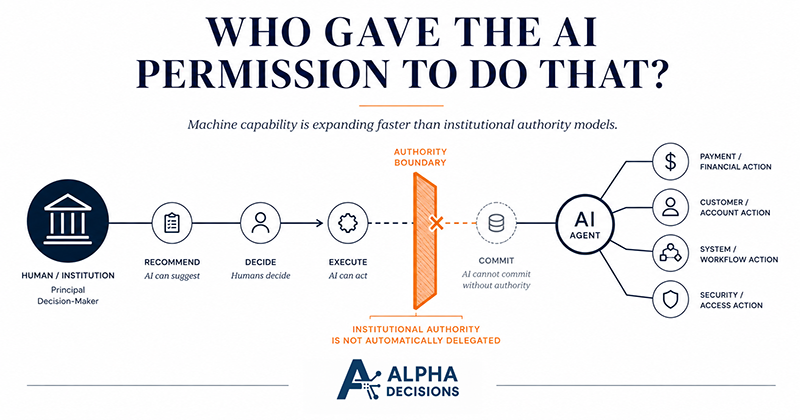
AI can perform work, but it cannot absorb institutional accountability. A model can recommend, an agent can act, and an algorithm can optimize, but the enterprise still owns the consequences.
Every increasingly autonomous decision system must therefore answer four questions: Was the action authorized? Did it remain within the boundaries of that authority? Can the organization verify what happened? Who owns the consequence?
These are not primarily technology questions. They are management questions, and they become more important as machines perform more of the work.
The Human Judgment Paradox
The popular narrative assumes a straightforward relationship: more machine intelligence means less need for human judgment. Enterprise reality is more complicated. More machine intelligence enables more autonomous activity, which creates more consequential exceptions and a greater need to allocate judgment intelligently.
Humans may participate in fewer individual decisions, but the decisions in which they remain involved may become much more important.
That is the paradox. AI does not eliminate human judgment. It changes where judgment creates value.
The management challenge of the AI age is therefore not to keep humans everywhere. It is to determine where humans must remain consequential. Organizations that answer that question well will be able to automate aggressively without losing control. Those that do not may discover that the greatest constraint on the autonomous enterprise is no longer artificial intelligence, but the architecture through which human judgment is allocated.


Comments