
From AI Experimentation to Decision Intelligence
Updated: Jun 6

For the past several years, organizations have been racing to deploy artificial intelligence.
Pilot projects have multiplied. New models are announced almost daily. Every function—from marketing and sales to operations and finance—is exploring how AI can improve performance.
Yet despite enormous investments, many organizations continue to struggle with a fundamental question:
How do we transform AI investments into measurable business outcomes?
The challenge is not a lack of technology. It is not a lack of data. In many cases, it is not even a lack of ideas.
The challenge is that most organizations are still focused on experimentation when they should be focused on decisions.
The Enterprise Already Has More Data Than It Can Use
Modern enterprises generate extraordinary volumes of information.
Customer transactions, supply chain events, financial records, machine telemetry, employee interactions, website activity, and operational systems continuously create new streams of data.
The problem is rarely data collection.
Most organizations already possess more information than they can effectively process.
The real question is:
How does that information improve decisions?
This distinction is important because information alone creates no value.
Decisions create value.
The Aircraft Analogy
Consider a modern commercial aircraft.
Thousands of sensors continuously generate information regarding engine performance, fuel consumption, environmental conditions, navigation systems, maintenance status, passenger operations, and aircraft health.
The same data is consumed by multiple stakeholders.
The pilot uses the information to make operational decisions during flight.
Maintenance teams use it to predict component failures and schedule repairs.
Operations teams use it to improve fleet utilization.
Scheduling teams use it to optimize aircraft availability.
Executives use aggregate information to guide investment decisions and long-term planning.
The data remains the same.
The decisions are different.
Value is not created by the data itself.
Value is created by the quality of the decisions enabled by that data.
Enterprises Operate the Same Way
Every organization functions much like the aircraft.
Data flows continuously throughout the enterprise.
Sales leaders make pricing and forecasting decisions.
Operations teams make resource allocation decisions.
Customer service organizations make response and escalation decisions.
Finance teams make investment decisions.
Executives make strategic decisions regarding growth, innovation, risk, and capital allocation.
Each decision requires different context, different expertise, and different information.
The objective is not simply to provide more dashboards.
The objective is to improve the quality, speed, and consistency of decisions.
Why AI Alone Is Not Enough
Many organizations approach AI as a technology initiative.
The conversation typically begins with:
"Where can we apply AI?"
A more useful question may be:
"Which decisions matter most, and how can we improve them?"
Artificial intelligence can generate predictions, recommendations, summaries, and insights.
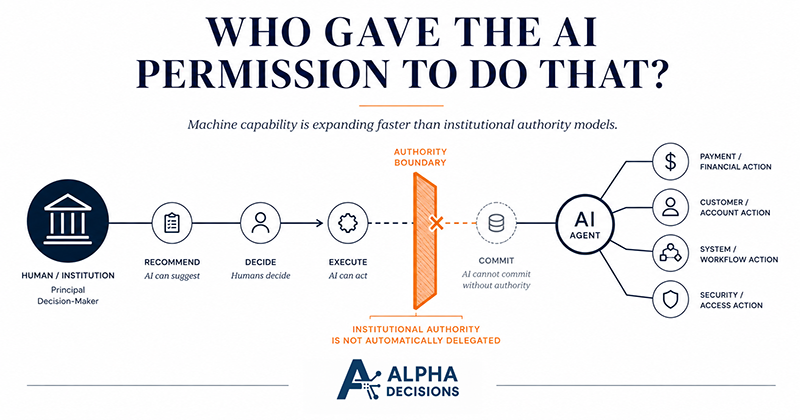
However, insights do not automatically create outcomes.
Organizations generate value only when those insights influence decisions and become embedded within business processes and operating models.
Without adoption, governance, accountability, and trust, AI simply creates additional information.
This explains why many AI initiatives struggle to move beyond experimentation.
The technology works.
The decision system does not change.
The Emergence of Decision Intelligence
Decision Intelligence represents the next phase of enterprise transformation.
Rather than focusing exclusively on data, analytics, or AI models, Decision Intelligence focuses on improving the decisions that drive business performance.
It recognizes that competitive advantage is ultimately determined by how effectively organizations make decisions.
Better decisions.
Faster decisions.
More consistent decisions.
More trusted decisions.
The organizations that systematically improve decision quality will outperform competitors in growth, efficiency, resilience, and innovation.
The Next Competitive Frontier
Every major technology wave has created a new source of advantage.
Enterprise systems improved operational efficiency.
The internet improved connectivity.
Cloud computing improved scalability and access.
Artificial intelligence improves the ability to generate insights.
The next competitive frontier may be something even more important:
The ability to systematically improve decision quality across the enterprise.
Organizations that successfully make this transition will move beyond isolated AI experiments and begin redesigning the way decisions are made.
The future belongs not to organizations with the most data.
It belongs to organizations that make the best decisions.
That future is where Decision Intelligence begins.


Comments