
AI's Missing Conversation: Decision Quality
Updated: Jun 6

Introduction
Every technology revolution begins with excitement about the technology itself.
In the 1990s, it was ERP. In the 2000s, it was the Internet. Then came cloud computing, cybersecurity, and now artificial intelligence. Each promised to transform how organizations operate and compete.
Many did. Many did not.
After spending more than three decades helping organizations adopt transformative technologies, I have observed a recurring pattern: technology creates capability, but competitive advantage comes from how organizations use those capabilities to make better decisions.
This distinction is becoming increasingly important in the age of AI.
Why Most AI Conversations Miss the Point
Today, most conversations about AI fall into three categories.
The first focuses on technology: models, agents, infrastructure, and benchmarks. The second focuses on governance: safety, ethics, security, and trust. The third focuses on productivity: automation, copilots, and efficiency.
All are important.
Yet they often overlook a more fundamental question: How does AI improve the quality of decisions?
Organizations make thousands of decisions every day. Which opportunities should we pursue? Which customers deserve additional investment? Which products should be accelerated? Which risks require action? Which resources should be reallocated?
Over time, these decisions determine performance far more than the technology itself.
Technology Creates Capability
History provides useful lessons.
The organizations that benefited most from ERP were not those that implemented the most software. They were the ones that improved operational decision-making. They gained visibility into their business, standardized processes, and made better choices about inventory, production, pricing, and customer service.
The organizations that benefited most from the Internet were not those with the most attractive websites. They were the ones that transformed how they made decisions about customers, partners, and supply chains.
Cloud computing did not create competitive advantage by itself. It accelerated the speed and flexibility of decisions. Organizations could experiment faster, scale faster, and respond to changing conditions faster.
Cybersecurity followed a similar path. The winners were not those who purchased the most security products. They were the organizations that improved their ability to identify, assess, and respond to risk.
AI is following the same pattern.
The Decision Quality Advantage
As AI becomes widely available, access to technology alone will not create sustainable competitive advantage. Powerful models are rapidly becoming accessible to everyone.
The differentiator will be an organization's ability to improve the quality, speed, and consistency of decisions.
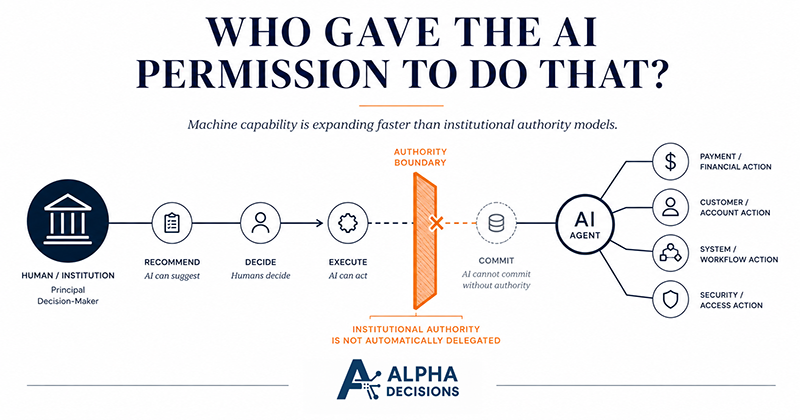
This requires more than technology. It requires industry expertise, organizational learning, governance, trust, and leadership. It requires understanding where human judgment adds value and where AI can augment that judgment.
The most successful organizations will not simply deploy AI. They will redesign how decisions are made.
Some decisions will become faster. Others will become more informed. Many will become more consistent. The organizations that learn to combine human expertise, organizational knowledge, and AI capabilities into superior decisions will outperform those that focus solely on technology adoption.
The Next Competitive Frontier
The next competitive frontier may not be artificial intelligence itself.
It may be decision quality.
Organizations have always competed through products, services, talent, and execution. Increasingly, they will compete through their ability to make better decisions than their competitors.
This shift has profound implications for leaders.
The executive role is evolving from being the source of answers to becoming the architect of decision systems. The goal is no longer simply to gather information. The goal is to create an environment where people and AI work together to make consistently better decisions.
Technology creates possibilities.
Human judgment determines direction.
Conclusion
The organizations that thrive in the AI era will not necessarily be those with the largest technology budgets or the most advanced models. They will be the organizations that use AI to improve decision quality across the enterprise.
Technology creates capability.
Better decisions create competitive advantage.


Comments